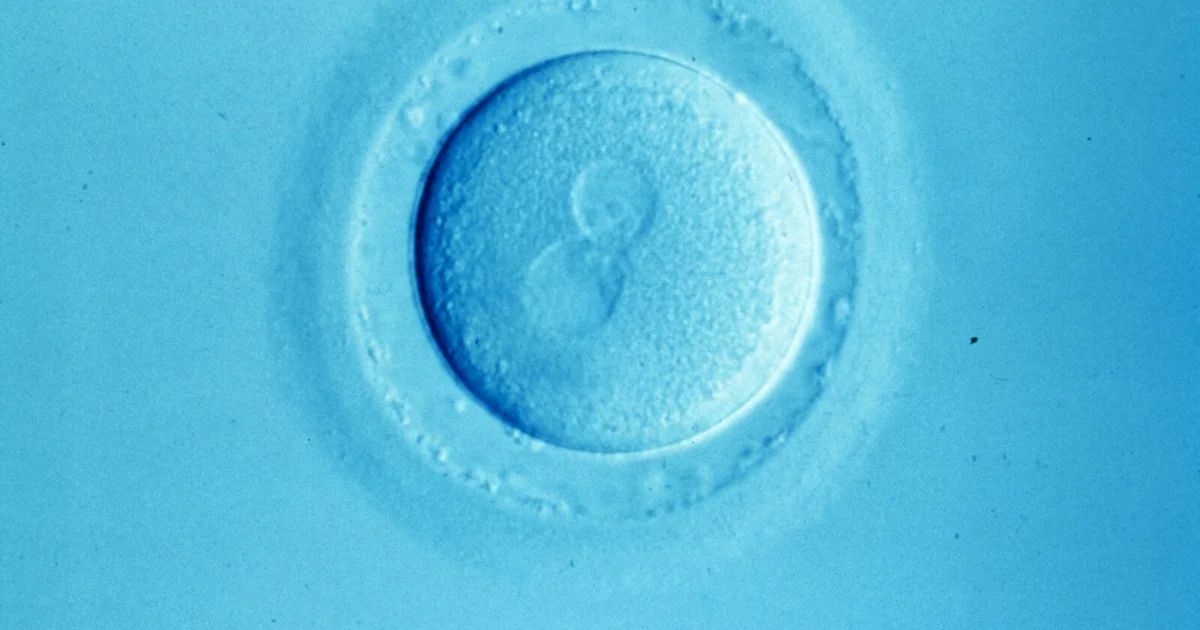
An egg is confirmed fertilized when the embryologist sees two pronuclei (2PN) inside it at the 16–18 hour check after insemination. In a well-run lab, roughly 70–85% of mature eggs fertilize normally, and total fertilization failure occurs in only 1–3% of ICSI cycles.
In natural conception, fertilization happens silently inside the fallopian tube — invisible and unfelt — so “how to tell if an egg is fertilized” only has a concrete answer in the IVF lab. This article explains how fertilization is confirmed, what the terms on your Day 1 report mean, and what happens when eggs do not fertilize.
Data in this article is sourced from the Alpha/ESHRE Istanbul and Vienna laboratory consensus documents, peer-reviewed literature indexed in PubMed, and public guidelines from ASRM and ESHRE, compiled by the ProIVF Medical Editorial Team and reviewed by the ProIVF Medical Advisory Board.
Where Does Fertilization Happen in Natural Conception?
Fertilization is the moment a sperm’s genetic material merges with the egg’s to form a new single cell, and in nature it takes place in the ampulla of the fallopian tube — the wide outer third — not in the uterus, ASRM.
The window is tight. After ovulation the egg stays fertilizable for roughly 12–24 hours, while sperm survive in the female reproductive tract for up to 5 days, so intercourse in the days before ovulation can still conceive. Once one sperm penetrates the egg’s outer shell (the zona pellucida), the egg instantly hardens that shell to block the rest — the first sign fertilization has begun, though nobody can observe it from outside.
For patients, the key point is that natural fertilization comes with no physical sensation at all. Implantation bleeding or early pregnancy symptoms appear days later, if at all, and the only reliable confirmation is a pregnancy test about two weeks after ovulation.
How Does the IVF Lab Confirm Fertilization?
In IVF, fertilization is not a mystery: the embryologist performs a pronuclear assessment the morning after retrieval, at 16–18 hours post-insemination, using the scoring standards of the Istanbul consensus on embryo assessment — Hum Reprod 2011.
What the Embryologist Counts
After a sperm enters an egg, the sperm’s DNA and the egg’s DNA each form a small nucleus called a pronucleus (PN) — one maternal, one paternal — and the embryologist counts them at the 16–18 hour check:
| Finding | Meaning | What happens to the embryo |
|---|---|---|
| 2PN | Two pronuclei — one maternal, one paternal | Normal fertilization. Embryo continues in culture |
| 0PN | No pronuclei seen | Not necessarily failure — pronuclei may have formed and faded before the check; the lab watches for cleavage before discarding |
| 1PN | One pronucleus | Abnormal fertilization; usually discarded, though some 1PN embryos from conventional IVF develop normally |
| 3PN or more | Three or more pronuclei | Polyspermy (extra sperm entered) or failed polar body extrusion; genetic content is abnormal — discarded |
Alongside the pronuclei, the embryologist checks for the second polar body, the small cell the egg discards once activated — its presence confirms the egg completed its final maturation step.
Why Exactly 16–18 Hours?
Check too early and the pronuclei have not finished forming; check too late and they have already merged and vanished ahead of the first division. The 16–18 hour window is the standardized time point laboratories use worldwide and one of the performance indicators in the Vienna consensus on ART laboratory monitoring — Hum Reprod Open 2017.
“Normal fertilization is clinically defined as the observation of two pronuclei and two polar bodies at 17 ± 1 hours after sperm and egg are combined.” — Chinese Society of Reproductive Medicine, Clinical Standards for Assisted Reproductive Technology and Sperm Banks (2021 revision)
What Is a Fertilized Egg Called?
“Fertilized egg” is the everyday phrase; embryologists use a precise name for each stage:
| Stage | Timing after fertilization | Lab name |
|---|---|---|
| Fertilized egg with 2PN | Day 1 (16–18 h after insemination) | Zygote |
| 2–4 cells | Day 2 | Cleavage-stage embryo |
| 6–10 cells | Day 3 | Cleavage-stage embryo (biopsy day at some clinics) |
| Compacted ball of many cells | Day 4 | Morula |
| Fluid-filled cavity with inner cell mass | Day 5–6 | Blastocyst (the usual transfer stage) |
So if your Day 1 report says “2PN × 8,” eight of your eggs became zygotes. By Day 5, roughly 40–50% of zygotes typically reach the blastocyst stage depending on egg quality and age — the next major hurdle after fertilization, ESHRE.
How Long Does Fertilization Take?
Fertilization is not a single instant but a sequence lasting about a day:
- Sperm entry and egg activation (0–1 hour): the sperm fuses with the egg membrane, and calcium waves complete the egg’s final maturation.
- Pronucleus formation (roughly 6–10 hours): maternal and paternal DNA each condense into a pronucleus.
- Pronuclear check (16–18 hours): the 2PN window the laboratory scores.
- Syngamy (roughly 20–22 hours): the two pronuclei dissolve and the chromosomes align together.
- First cleavage (roughly 24–27 hours): the zygote divides into two cells — the embryo’s first division.
This timeline is why clinics report fertilization results the day after retrieval and give the next update (cleavage) about 24 hours after that.
What Is a Normal Fertilization Rate?
Not every retrieved egg can fertilize: only mature eggs (metaphase II) have completed the meiotic preparation sperm require, while immature eggs (GV or MI stage) cannot fertilize and are not counted against the laboratory — Fertil Steril 2026.
Among mature eggs, the Vienna consensus sets laboratory benchmarks: a competent lab should reach at least 65% normal fertilization, with high-performing labs achieving 75% for conventional IVF and around 80% for ICSI. In practice, patients with good egg quality commonly hear figures in the 70–85% range.
“For the fertilization rate, the competency value is 65% and the benchmark value is 75%.” — ESHRE and Alpha Scientists in Reproductive Medicine, The Vienna consensus: report of an expert meeting on the development of ART laboratory performance indicators (Hum Reprod, 2017)
What lowers the rate is usually the egg, not the lab: female age over 35 reduces the share of eggs with normal chromosomes and normal activation machinery. Severe sperm problems (very low count or poor morphology) also lower fertilization, which is why semen analysis results decide whether conventional IVF or ICSI is used.
What If the Eggs Don’t Fertilize?
Sometimes none of the mature eggs fertilize — total fertilization failure (TFF). It occurs in only 1–3% of ICSI cycles, and somewhat more often with conventional IVF — Hum Reprod Update 2023.
The leading cause is oocyte activation deficiency (OAD): the sperm enters the egg, but the egg never fires the calcium signal that starts development — and the defect can sit on either the egg side or the sperm side — Hum Reprod Update 2023. Next steps depend on timing and cause:
- Rescue ICSI: if eggs were inseminated by conventional IVF and show no fertilization at the check, injecting a single sperm into each egg within the first 24 hours can still rescue some — Fertil Steril 2026.
- Artificial oocyte activation (AOA): for suspected OAD, the next cycle uses a calcium ionophore to chemically trigger the missing calcium wave. A 2024 Cochrane review summarizes the evidence, and our guide to calcium ionophore treatment covers it in depth.
- Sperm-side causes: testing for PLCζ, the sperm protein that triggers activation, can identify a sperm defect behind repeated failure.
A single episode of TFF is not a verdict — with diagnosis and AOA, many couples fertilize normally in a later cycle.
Three Patients’ Fertilization Days
The patient stories below are shared with consent. Names and identifying details have been changed to protect privacy.
Case 1 — Nine of ten. A 34-year-old at a Boston clinic had 12 eggs retrieved in her first IVF cycle, 10 of them mature, and her Day 1 call reported 9 fertilized normally. “When the nurse said ‘nine of ten,’ I burst out crying — I’d spent the whole morning convinced every one had failed. Then I asked her to repeat the 2PN part three times because I didn’t know what it meant.” Her cycle cost about $16,000 out of pocket; six embryos became blastocysts, and one transfer led to an ongoing pregnancy.
Case 2 — Two of seven, then the switch. A 37-year-old couple in Bangkok with unexplained infertility fertilized only 2 of 7 mature eggs in their first conventional IVF cycle. “Two felt like a sentence — we had flown in from Malaysia and paid about $11,000 for that cycle.” Because sperm parameters were borderline, the clinic switched to ICSI for cycle two: 7 of 9 mature eggs fertilized, and the couple froze two blastocysts. Their story shows how much the fertilization method matters when sperm quality is marginal.
Case 3 — Zero, then answers. A 32-year-old in Chicago had 0 of 11 mature eggs fertilize in her first ICSI cycle — total fertilization failure. “I remember the embryologist’s voice going quiet. Zero is a number nobody prepares you for.” Her clinic suspected oocyte activation deficiency, and her second cycle used calcium ionophore activation: 8 of 10 eggs fertilized normally, one fresh transfer led to a live birth, and the second cycle cost roughly $19,000 including medication. Her path matches exactly what the Hum Reprod Update review describes: diagnose, then activate.
FAQ
Q: Can I tell at home whether my egg was fertilized?
No — fertilization produces no symptoms and happens in a lab dish (IVF) or inside the fallopian tube. The earliest home signal is a positive pregnancy test 9–10 days after a Day 5 transfer, and only if implantation also succeeds.
Q: What does 2PN mean on my fertilization report?
2PN means two pronuclei were seen inside the egg at the 16–18 hour check — one from the egg, one from the sperm. It is the standard definition of normal fertilization, reported for each egg individually.
Q: Does a fertilized egg mean I’m pregnant?
Not yet — fertilization is only step one of the chain (zygote → cleavage → blastocyst → implantation → positive hCG). Roughly 40–50% of zygotes reach the blastocyst stage, and clinics transfer or freeze blastocysts around Day 5–6.
Q: When will I get the fertilization results?
The morning after egg retrieval — 16–18 hours after insemination — the lab completes the pronuclear check, and clinics usually call or message the same day with your 2PN count.
Q: What if zero eggs fertilized?
Ask your clinic about rescue ICSI (possible within the first 24 hours if conventional IVF was used) and oocyte activation testing for the next cycle. Total fertilization failure affects only 1–3% of ICSI cycles, and artificial oocyte activation restores normal fertilization for many of these couples.
Q: How many fertilized eggs become embryos?
From zygote to blastocyst, expect roughly 40–50% to survive to Day 5, with lower rates for women over 38. The attrition happens after fertilization — cleavage arrest is the next separate hurdle.
Q: Is ICSI fertilization different from conventional IVF fertilization?
The 2PN check is identical, but the rates differ slightly: benchmark normal fertilization is about 75% for conventional IVF and 80% for ICSI in high-performing labs. ICSI bypasses the sperm-entry step entirely, which is why it is used for male-factor cases and for eggs that failed conventional fertilization.
Making Sense of Your Day 1 Report
Fertilization day is the first verdict of an IVF cycle, and reading the 2PN report well turns an anxious phone call into usable information. Three practical steps:
- Write down your Day 1 numbers — mature eggs, 2PN count, Day 3 cleavage, Day 5 blastocysts — because this trail is what doctors use to adjust the next cycle.
- Ask what your lab’s normal fertilization rate is — the Vienna consensus sets 65% as the minimum competency line, and a lab below it deserves questions.
- If fertilization was low or zero, ask specifically about sperm-side testing, rescue ICSI, and calcium ionophore activation before deciding on the next attempt.
If you are comparing clinics — including how their labs report fertilization and blastocyst rates — browse our hospital directory, read the full walkthrough of how IVF is done step by step, or learn what happens inside the IVF laboratory and how embryos develop from zygote to blastocyst.
This article was written by the ProIVF Medical Editorial Team and reviewed by the ProIVF Medical Advisory Board, based on publicly available data from the Alpha/ESHRE Istanbul and Vienna consensus documents, peer-reviewed studies indexed in PubMed, and ASRM and ESHRE patient guidance, to provide objective, accurate information for patients.
Medical disclaimer: This content is for informational purposes only and does not constitute medical advice. Fertility treatment outcomes vary by individual diagnosis, age, and clinic. Always consult a licensed reproductive specialist about your specific situation. Questions? Contact us.
Last updated: September 14, 2026