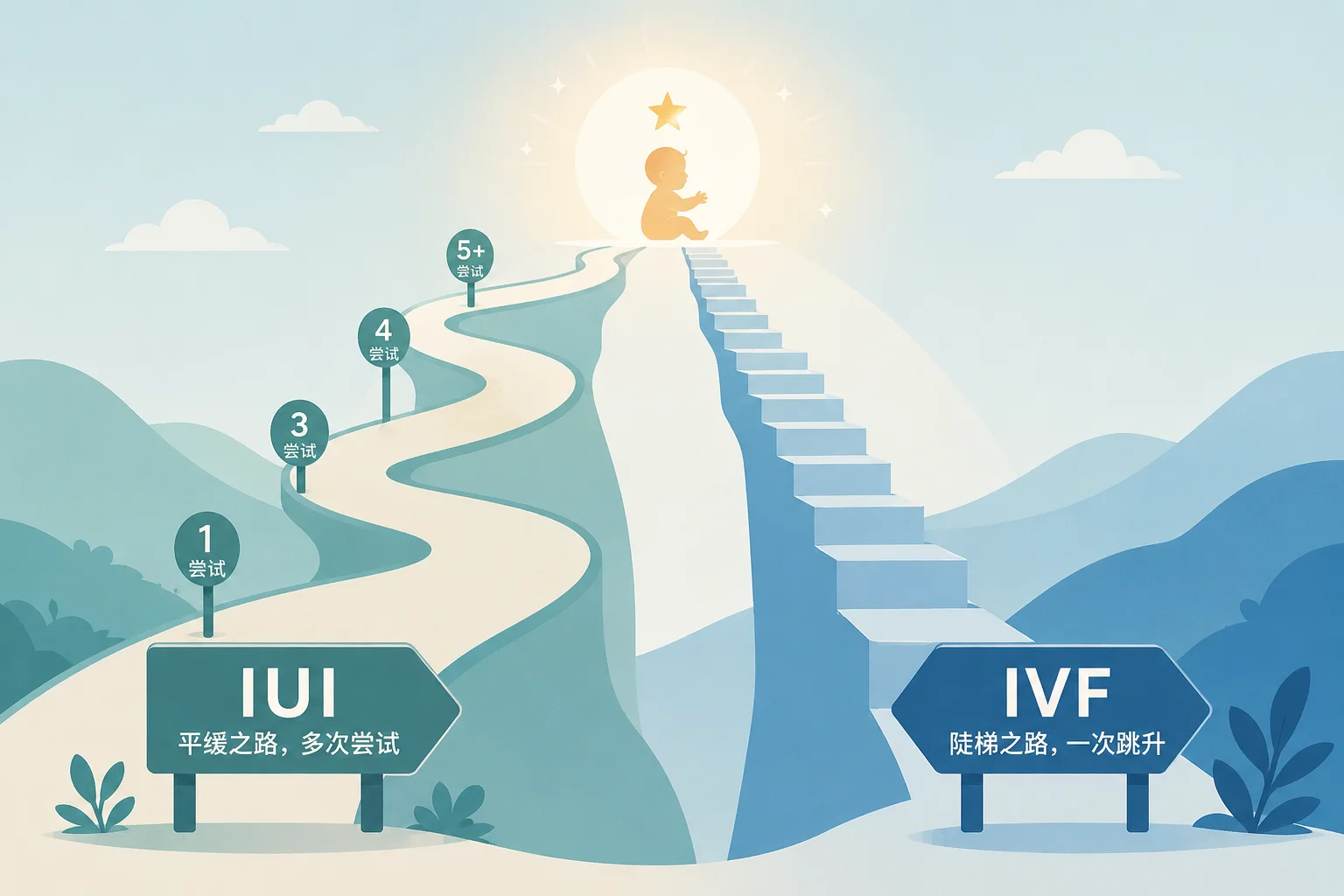
IUI costs $300 to $1,000 per cycle (plus medication) with a 10-20% success rate, while a single IVF cycle costs $15,000 to $30,000 and reaches 40-55% success for women under 35. The right first step depends mainly on your age, diagnosis, and how much time you can afford to spend.
IUI vs IVF at a Glance
| Factor | IUI | IVF |
|---|---|---|
| Success rate per cycle | 10-20% (age dependent) | 40-55% (under 35) |
| Cost per cycle (US) | $300 - $1,000 + meds | $15,000 - $30,000 + meds |
| Invasiveness | Minimal (catheter through cervix) | Surgical (egg retrieval under sedation) |
| Time per cycle | 2-4 weeks | 4-6 weeks |
| Medication required | Optional (oral or injectable) | Required (injectable gonadotropins) |
| Egg retrieval | No | Yes (outpatient surgery) |
| Best for | Unexplained infertility, mild male factor, cervical issues, ovulation disorders | Blocked tubes, severe male factor, advanced maternal age, genetic testing, prior IUI failure |
| Multiple birth risk | 10-15% (higher with injectables) | 10-30% (depends on number transferred) |
One IVF cycle costs the same as 10-30 IUI cycles, but three IUI cycles ($900-$3,000) deliver roughly the same cumulative pregnancy chance as one IVF cycle.
What Is IUI and How Does It Work?
Intrauterine insemination (IUI) places washed, prepared sperm directly into the uterus at ovulation — the treatment often called “artificial insemination.” The procedure takes about 5 minutes, needs no anesthesia, and simply gives sperm a head start past the cervix; the sperm still fertilize the egg on their own.
IUI can run in a natural cycle or with oral medications (clomiphene, letrozole) to grow one or two follicles. Some protocols add low-dose injectables, which raise success rates but also the chance of multiples.
What Are IUI Success Rates by Age?
| Age | Success Rate Per Cycle | Cumulative After 3 Cycles |
|---|---|---|
| Under 35 | 15-20% | 40-50% |
| 35-37 | 10-15% | 30-40% |
| 38-40 | 8-12% | 20-30% |
| Over 40 | 5-8% | 10-15% |
Most clinics evaluate after 3-4 IUI cycles, because the odds of additional IUI succeeding drop sharply beyond that point.
What Is IVF and Why Does It Work Better Per Cycle?
In vitro fertilization (IVF) stimulates the ovaries to produce multiple eggs, retrieves them surgically, fertilizes them with sperm in the laboratory, and transfers embryos back into the uterus. IVF completely bypasses the fallopian tubes and allows preimplantation genetic screening (PGT-A) of embryos — the main reasons its per-cycle success rate far exceeds IUI.
What Are IVF Success Rates by Age?
According to the CDC’s ART success rates report, live birth rates per cycle using fresh embryos from a patient’s own eggs are:
| Age | Success Rate Per Cycle (Live Birth) |
|---|---|
| Under 35 | 45-55% |
| 35-37 | 35-40% |
| 38-40 | 20-30% |
| Over 40 | 8-15% |
Combined with PGT-A screening and frozen embryo transfer (FET), women under 40 can reach 60-70% success per transfer of a chromosomally normal embryo.
How Do IUI and IVF Costs Compare?
The cost gap is the single biggest factor in most patients’ decision. A full IVF cycle costs 10-30 times as much as a single IUI cycle.
IUI Cost Breakdown
| Item | Cost |
|---|---|
| Monitoring (ultrasound + bloodwork) | $200 - $500 per cycle |
| IUI procedure | $200 - $600 |
| Sperm washing | $100 - $300 |
| Oral medication (clomiphene/letrozole) | $20 - $100 |
| Injectable medication (if used) | $500 - $2,000 |
| Total per cycle (no injectables) | $300 - $1,000 |
| Total per cycle (with injectables) | $800 - $3,000 |
IVF Cost Breakdown
| Item | Cost |
|---|---|
| IVF cycle (monitoring + retrieval + transfer) | $12,000 - $15,000 |
| Medications | $3,000 - $6,000 |
| ICSI (if needed) | $1,500 - $2,500 |
| PGT-A (if used) | $3,000 - $5,000 |
| Total per cycle | $15,000 - $30,000 |
Because IUI succeeds 10-20% of the time per cycle versus IVF’s 40-55%, three IUI cycles ($900-$3,000) roughly match one IVF cycle ($15,000-$30,000) in cumulative pregnancy chance. See our country-by-country IVF cost comparison for full pricing detail.
For patients under 35 with favorable diagnoses, starting with IUI is both medically reasonable and financially prudent; for patients over 38 or with tubal factor, IVF is usually the better first choice.
How Long Does Each Treatment Take?
| Phase | IUI | IVF |
|---|---|---|
| Initial testing | 1-2 weeks | 1-2 weeks |
| Cycle start | Day 1 of period | Day 1 of period |
| Medication phase | 5-10 days (if using meds) | 10-14 days |
| Procedure | Day 12-16 (insemination) | Day 12-16 (retrieval) + Day 17-19 (transfer) |
| Pregnancy test | 14 days after IUI | 9-12 days after transfer |
| Total cycle duration | 2-4 weeks | 4-6 weeks |
IVF adds roughly two weeks per cycle, mainly because embryos need 5-6 days of laboratory culture before transfer.
Who Should Start with IUI?
IUI is the standard first-line treatment in six situations:
- Unexplained infertility — no identifiable cause after standard testing
- Mild male factor — slightly below-normal sperm count or motility
- Cervical factor — cervical mucus issues or a hostile cervical environment
- Ovulation disorders — PCOS or irregular ovulation, where IUI with ovulation induction works well
- Donor sperm — single women or same-sex couples using frozen donor sperm
- Mild endometriosis — stage I or II without tubal damage
When Is IUI Not an Option?
IUI is contraindicated when any of the following apply:
- Blocked or damaged fallopian tubes on both sides
- Severe male factor (very low count, poor motility, high DNA fragmentation)
- Moderate to severe endometriosis
- Three or four prior IUI cycles without pregnancy
- A need for PGT-A or PGT-M genetic testing
When Should You Skip IUI and Go Straight to IVF?
IVF is the recommended first-line treatment when:
- Blocked or absent fallopian tubes — the clearest IVF indication; see our tubal factor infertility guide
- Severe male factor — very low count, poor motility, or high DNA fragmentation almost always requires ICSI
- Age 38 or older — time is the biggest cost, and IVF offers the best per-cycle odds (see IVF success rate by age)
- Diminished ovarian reserve — low AMH or low antral follicle count; IVF recovers the maximum number of eggs
- Genetic testing needed — PGT-A or PGT-M requires embryo biopsy, which only IVF provides
- Repeated IUI failure — after 3-4 failed cycles, further IUI has very low returns
- Tubal ligation or failed reversal — IVF is the only path to pregnancy
Is Trying One Round of IUI Before IVF Worth It?
Some reproductive endocrinologists support a single IUI trial even when IVF is the likely destination, for three reasons:
- A small share of patients do conceive with IUI, avoiding IVF’s cost and burden entirely
- The IUI cycle reveals how the patient responds to stimulation, useful information for the IVF protocol
- For many patients, the psychological comfort of “having tried everything” before IVF genuinely matters
Other experts argue that for patients over 38 or with a clear diagnosis, IUI wastes time and money.
“For couples with unexplained or mild infertility, it is reasonable to attempt three to four cycles of IUI with ovarian stimulation before proceeding to IVF.” — American Society for Reproductive Medicine (ASRM) practice guidance
What Do Real Patient Journeys Look Like?
Case 1: IUI worked. A 32-year-old couple tried for 18 months with every test normal — unexplained infertility.
After two medicated IUI cycles costing roughly $1,100 in total, she conceived and delivered a healthy baby.
Case 2: IUI first, then IVF. A 36-year-old completed three IUI cycles with injectable medications, spending about $2,800 in total. All failed. She moved to IVF, spent about $17,000 on a first cycle with PGT-A, and conceived on the very first frozen transfer — she now wishes she had switched after the second failed IUI.
Case 3: Straight to IVF. At 40 with an AMH of 0.8, her doctor recommended skipping IUI entirely. She completed one IVF cycle in Thailand for about $8,000 including medications, biopsied her embryos for PGT-A, and transferred a single chromosomally normal embryo, resulting in a live birth. Starting with IUI would have cost her the one resource she could not spare: time.
What Are the Risks of IUI vs IVF?
Both treatments are safe for most patients, but their risk profiles differ.
IUI Risks
- Multiples — with injectable medications, the risk of twins or higher-order multiples rises to 10-15%
- Mild ovarian hyperstimulation — uncommon with oral medications, and mild cases resolve on their own
- Infection — rare, under 1%
- Cycle cancellation — too many follicles developing may force cancellation to prevent multiples
IVF Risks
- OHSS (ovarian hyperstimulation syndrome) — affects 3-5% of cycles, more common with PCOS
- Multiples — elective single embryo transfer (eSET) keeps this risk low
- Surgical risks — bleeding, infection, or injury from egg retrieval occur in under 1% of retrievals
- Ectopic pregnancy — slightly higher than with natural conception
- Emotional and financial burden — heavier medication load, more invasive procedures, higher stakes
Does Insurance Cover IUI and IVF Differently?
US insurance treats the two procedures very differently:
| Procedure | States with Mandated Coverage | Typical Coverage |
|---|---|---|
| IUI | Included in most mandate states | Often covered partially or fully as a medical procedure |
| IVF | 15 states | Usually capped at $10,000 - $25,000 lifetime |
| Medications | Varies by state | Less frequently covered, especially for IVF |
Because many insurance frameworks classify IUI as a “medical procedure” rather than “advanced reproductive technology,” it is far more likely to be paid for — one reason insurers push step therapy from IUI to IVF. Current clinic-level outcome and utilization data are published by the Society for Assisted Reproductive Technology, SART.
FAQ
Q: Which is more successful, IUI or IVF?
IVF has the significantly higher per-cycle success rate: 45-55% live birth under 35 versus 15-20% for IUI. Three IUI cycles accumulate to 40-50%, approaching a single IVF cycle at roughly one-tenth the cost.
Q: How much cheaper is IUI than IVF?
A single IUI cycle costs $300-$1,000 versus $15,000-$30,000 for IVF — 10 to 30 times cheaper per cycle. Measured per live birth, IUI averages roughly $15,000-$25,000 while IVF averages $40,000-$60,000.
Q: Does IUI hurt?
Most women compare IUI to a Pap smear — mild cramping during and briefly after a procedure that takes about 5 minutes and needs no anesthesia. IVF egg retrieval is done under sedation, so the procedure itself is painless but more invasive overall.
Q: How many IUI cycles should I try before IVF?
ASRM practice guidance supports a maximum of 3-4 IUI cycles under age 38 and 1-2 cycles at 38 or older. After 3-4 failures, the per-cycle chance with additional IUI falls below 5%.
Q: Can I do IUI with donor sperm?
Yes — donor-sperm IUI is the standard treatment for single women and same-sex female couples. With accredited bank sperm, success rates match IUI with partner sperm at 15-20% per cycle for women under 35.
Q: Will insurance cover my IUI?
More often than IVF: RESOLVE counts 25 states plus Washington, D.C. with a fertility insurance law and 15 that require IVF coverage, and IUI is likelier to be included as a basic medical procedure. Your specific plan’s terms decide, so verify before starting.
Q: Can I switch clinics between IUI and IVF?
Yes. Many patients complete their 3-4 IUI cycles at a lower-cost clinic and transfer to an IVF-specialized center afterward.
Bring your stimulation-response records and test results so nothing is repeated.
Your Next Step: Matching the Treatment to Your Situation
Choose IUI if you are under 35-36, have no identifiable problem or only a mild one, and want a low-cost, low-burden starting point — three cycles deliver a reasonable cumulative chance for under $3,000. Choose IVF if you are over 37, have blocked tubes, severe male factor, or diminished ovarian reserve, or have already failed 3-4 IUI cycles.
Many patients sit in the middle: young enough for IUI to be reasonable, but eager not to lose time. For them, a consultation reviewing specific AMH, follicle count, and sperm parameters is the fastest way to a confident decision. If US pricing is the barrier, treatment abroad runs 30-40% of American costs — browse vetted international clinics or request a personalized comparison.
This guide was written by the ProIVF Medical Editorial Team and reviewed by the ProIVF Medical Advisory Board for clinical accuracy. It is informational only and does not replace medical advice — confirm all pricing directly with clinics and discuss your plan with a board-certified reproductive endocrinologist. Last updated: June 30, 2026.