The hCG trigger shot — the “night shot” or final maturation injection — is the single most time-critical injection of an IVF cycle: one needle decides whether the follicles that grew over 10-14 days release mature eggs at exactly the right moment. Inject too early and the eggs are immature; too late and you may ovulate before retrieval.
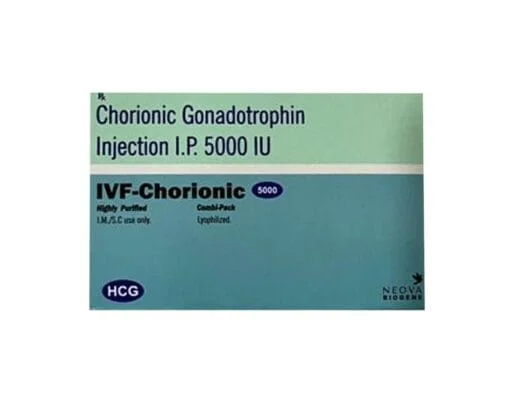
For decades, hCG 5,000 IU — 5,000 international units of human chorionic gonadotropin — has been one of the most widely used trigger doses worldwide. This guide covers how it works, how it compares with other trigger options, the exact 34-36 hour timing window, OHSS risk stratification, costs by country, and a practical framework for choosing the right trigger for your profile.
The full journey from the first FSH injection to trigger day is detailed in our IVF medications guide. The trigger deserves its own deep dive because it sits at a unique intersection: timing, trigger type, and dose each carry their own risks — the wrong type sends OHSS risk soaring, and the wrong dose can leave eggs immature.
Key Statistics at a Glance
| Metric | Value | Source |
|---|---|---|
| Time from trigger to egg retrieval | 34-36 hours | ASRM 2023 |
| Egg maturation rate with adequate hCG trigger | 85-95% | Fertil Steril 2021 |
| OHSS incidence with hCG trigger (all patients) | 3-8% | ASRM OHSS Guideline 2022 |
| OHSS incidence with hCG trigger (PCOS patients) | 15-25% | Cochrane 2022 |
| OHSS reduction with Lupron trigger vs hCG | 80-90% reduction | Cochrane 2022 |
| Dual trigger (hCG + Lupron) improvement in mature oocyte yield | 15-25% | Fertil Steril 2023 |
| Live birth rate per fresh transfer with hCG trigger | 35-45% | SART 2023 |
| Cost of urinary hCG 5,000 IU (US pharmacy) | $100-$250 | Multiple pharmacy survey |
| Cost of urinary hCG 5,000 IU (China, domestic brand) | ¥150-¥400 | Multiple clinic survey |
| hCG half-life in circulation | ~36 hours | ASRM 2023 |
Sources: ASRM Practice Guidelines, CDC ART Surveillance, Cochrane Library 2022, SART National Summary, Fertility and Sterility 2021-2023
What Is the hCG 5000 IU Trigger Shot and How Does It Work?
During a natural menstrual cycle, a surge of luteinizing hormone (LH) from the pituitary gland triggers the dominant follicle’s final maturation — the oocyte resumes meiosis, the cumulus cells expand, and ovulation occurs roughly 36-40 hours later.
In IVF, we need to replicate that LH surge precisely, but on our schedule. Human chorionic gonadotropin (hCG) is the ideal pharmacological substitute because it binds the same LH/hCG receptor on granulosa cells with even greater affinity and a far longer half-life — about 36 hours for hCG vs roughly 20 minutes for natural LH.
When you inject hCG 5,000 IU:
- Within minutes, the hormone binds to LH receptors on the follicle cells
- A cascade of enzymatic reactions resumes meiosis in the oocyte
- Cumulus cells begin producing hyaluronic acid and the cumulus mass expands
- The oocyte completes its first meiotic division and reaches metaphase II (MII) — the stage required for fertilization
- Progesterone production shifts from theca cells to luteinized granulosa cells, preparing the endometrium for implantation
The 5,000 IU dose is considered a “standard” trigger dose for most IVF patients. Some clinics use 10,000 IU for patients with higher body weight or poor prior response, while doses as low as 2,500 IU are sometimes used in low-risk, lean patients. The 5,000 IU dose is the most commonly prescribed middle ground: sufficient for complete oocyte maturation in most patients while keeping the luteal-phase hCG exposure that drives OHSS to a minimum.
Clinical insight from ASRM 2023: A 5,000 IU hCG dose achieves serum hCG levels of approximately 150-250 mIU/mL at 36 hours post-injection — well above the threshold needed for complete oocyte maturation (estimated at ~50 mIU/mL). The excess hCG beyond what maturation requires is what drives the luteal phase and, in susceptible patients, triggers OHSS. This is why trigger type and dose selection is a balancing act between efficacy and safety.
How Does hCG 5,000 IU Compare to Other Trigger Options?
This is one of the most consequential clinical decisions of an IVF cycle, yet many patients never realize a choice exists. While many clinics default to a single trigger type, the evidence increasingly supports individualized trigger selection.
| Feature | hCG 5,000 IU | hCG 10,000 IU | Ovidrel 250 mcg (r-hCG) | Lupron Trigger | Dual Trigger (hCG + Lupron) |
|---|---|---|---|---|---|
| Molecule | Urinary hCG | Urinary hCG | Recombinant hCG | GnRH agonist | hCG + GnRH agonist |
| Onset of action | ~12 hours | ~12 hours | ~12 hours | ~4-6 hours | ~4-6 hours (fast component) |
| Duration of LH activity | ~6 days | ~10 days | ~6 days | ~24 hours | ~24 hours + hCG tail |
| OHSS risk | Moderate-High | High | Moderate | Very Low | Low-Moderate |
| Mature oocyte rate | 85-95% | 85-95% | 85-95% | 80-90% | 90-98% |
| Luteal phase support needed | Standard | Standard | Standard | Extra (severe luteal phase defect) | Standard |
| Live birth rate per transfer | 35-45% | 35-45% | Comparable to hCG | 30-40% (but safer) | Comparable to hCG 5,000 |
| Typical cost (US) | $100-$250 | $150-$300 | $250-$400 | $300-$500 | $400-$700 |
| Typical cost (China) | ¥150-¥400 | ¥200-¥500 | ¥500-¥1,000 | ¥400-¥800 | ¥600-¥1,200 |
Data compiled from: ASRM 2023 Practice Guidelines, Cochrane 2022 (OHSS Prevention Review), Fertil Steril 2023 (Dual Trigger Study), and a multi-pharmacy pricing survey conducted July 2026.
Who Should Use Which Trigger?
| Trigger Type | Best For | Avoid In |
|---|---|---|
| hCG 5,000 IU | Standard-risk patients, first IVF cycle, normal AMH (1-4 ng/mL) | High OHSS risk (PCOS, AMH >4, AFC >20), prior severe OHSS |
| hCG 10,000 IU | BMI over 30, prior poor maturation with 5,000 IU | All OHSS-risk patients — rarely used in modern practice |
| Ovidrel 250 mcg | Patients preferring a recombinant product (theoretically slightly lower immunogenicity) | Same restrictions as urinary hCG |
| Lupron trigger | First-line for OHSS-risk patients: PCOS, AMH >4, AFC >20, prior OHSS | Poor pituitary reserve, planned fresh transfer (luteal phase defect) |
| Dual trigger | Low-normal oocyte yield, prior poor maturation, patients needing both safety and efficacy | Standard-risk patients where monotherapy suffices |
Why Are 34-36 Hours So Critical for the Trigger Shot?
The interval between trigger injection and egg retrieval is the most tightly controlled window in any IVF cycle.
- Under 34 hours: most oocytes have not yet completed meiosis I, so the MII (mature) egg rate drops significantly
- 34-36 hours: peak oocyte maturation — 85-95% of retrieved eggs are at the MII stage
- 36-38 hours: still acceptable, but spontaneous ovulation risk begins to rise
- Over 38 hours: high risk of spontaneous ovulation — cycle cancellation or an “empty follicle” retrieval
- Over 40 hours: most follicles will have already ovulated
In practice, clinics schedule retrieval at 35.5-36 hours post-trigger:
| Trigger Time | Retrieval Time | Interval |
|---|---|---|
| 9:00 PM (Day 1) | 8:30-9:00 AM (Day 3) | 35.5-36 hours |
| 10:00 PM (Day 1) | 9:30-10:00 AM (Day 3) | 35.5-36 hours |
| 8:00 PM (Day 1) | 7:30-8:00 AM (Day 3) | 35.5-36 hours |
Patients are explicitly instructed not to deviate from the prescribed injection time — a difference of even 30 minutes can affect the mature-egg yield. One patient from Los Angeles shares:
“My clinic sent me home with a printed card that had my trigger time in bold — 9:15 PM, not 9:00, not 9:30, exactly 9:15. The embryologist said she’s seen cycles where a 45-minute delay dropped the mature egg rate from 90% to 60%. I set three alarms.”
A practical note on hCG timing: because hCG has a long half-life (~36 hours), its window is slightly more forgiving than a Lupron trigger, whose short LH surge demands tighter precision. The standard 34-36 hour window still applies.
Step by Step: What Happens on Trigger Day
Before the injection
- Your nurse or doctor confirms which trigger medication to use and the exact injection time
- The medication is typically refrigerated and should sit out 15-30 minutes to reach room temperature before injecting
- Verify the dose and drug type — the most common error is patients accidentally administering the wrong medication
The injection itself
hCG 5,000 IU (urinary brands such as Pregnyl, Novarel, Profasi, or China’s domestic Lishenbao) is typically given as an intramuscular (IM) injection — deeper than the subcutaneous FSH shots used for stimulation:
- Needle length: usually 1-1.5 inches (25-38 mm) for IM injection
- Site: the upper outer quadrant of the gluteal muscle (buttock) or the outer thigh (vastus lateralis)
- Technique: inject the diluent into the vial, swirl gently until the powder fully dissolves (do not shake), draw back into the syringe, and inject firmly into the muscle
- Sensation: patients describe “a deeper, fuller ache” than the stimulation shots — not necessarily more painful, but distinctly different
Some clinics allow subcutaneous administration for certain hCG formulations. Always follow the specific instructions from your pharmacy and clinic.
What to expect after the injection
| Timeline | What Happens |
|---|---|
| 15-30 min | Mild injection-site soreness; possible mild cramping as the ovaries respond |
| 12-24 hours | Bloating may increase as follicles keep expanding |
| 24-34 hours | Many women report mild pelvic pressure, breast tenderness, and mood shifts from the hormonal surge |
| 35-36 hours | Egg retrieval |
| 36+ hours | hCG keeps circulating — this sustained luteal stimulation drives post-retrieval progesterone support |
OHSS Risk: The Most Important Consideration with an hCG Trigger
Ovarian Hyperstimulation Syndrome (OHSS) is the most serious complication of hCG-triggered cycles. Understanding your personal risk profile — and discussing alternatives — should happen before the trigger decision, not after.
The American Society for Reproductive Medicine (ASRM) classifies OHSS risk from a combination of patient and cycle parameters:
| Risk Level | AMH | AFC | E2 on trigger day | Follicle count | Recommended Trigger |
|---|---|---|---|---|---|
| Low | <1.5 ng/mL | <10 | <2,000 pg/mL | <15 | hCG 5,000 IU |
| Moderate | 1.5-3.5 ng/mL | 10-18 | 2,000-3,500 pg/mL | 15-24 | hCG 5,000 IU with careful monitoring, or dual trigger |
| High | 3.5-5.0 ng/mL | 18-24 | 3,500-5,000 pg/mL | 25-34 | Lupron trigger or dual trigger preferred |
| Very High | >5.0 ng/mL | >24 | >5,000 pg/mL | >35 | Lupron trigger strongly recommended |
Source: ASRM OHSS Prevention and Management Guidelines, 2022.
Can You Self-Assess Your OHSS Risk?
Before trigger day, run through this 4-factor check — each “yes” adds risk:
- Do you have PCOS, or polycystic-appearing ovaries on ultrasound?
- Is your AMH above 3.5 ng/mL?
- Did your last monitoring ultrasound show more than 15 follicles at 10 mm or larger?
- Have you had significant bloating or rapid weight gain (over 2 kg) in the last 3 days of stimulation?
0 yes: Low risk — hCG 5,000 IU is likely appropriate. 1-2 yes: Moderate risk — discuss dual trigger or Lupron trigger with your doctor. 3-4 yes: High risk — strongly consider a Lupron trigger, and raise it immediately if your clinic has not discussed alternatives.
What Are the OHSS Warning Signs After Trigger?
Contact your clinic immediately if you experience any of the following after your hCG trigger:
- Severe abdominal pain or distension
- Rapid weight gain of more than 1 kg per day
- Nausea severe enough to prevent eating
- Markedly decreased urine output
- Shortness of breath
How Much Does the hCG 5000 IU Trigger Shot Cost by Country?
Trigger-shot prices vary widely by country, pharmacy, and brand. Here is a practical reference:
| Country | Typical Cost (hCG 5,000 IU) | Common Brands | Notes |
|---|---|---|---|
| United States | $100-$250 | Pregnyl, Novarel, Profasi | Insurance may cover it if a fertility drug benefit exists |
| United Kingdom | £30-£80 | Pregnyl, Gonasi | NHS-funded or private pharmacy purchase |
| Thailand | ฿800-฿2,500 | Pregnyl, Novarel | Significantly cheaper than Western countries |
| China (domestic) | ¥150-¥400 | Lishenbao and similar | Widely available and affordable |
| China (imported) | ¥500-¥1,200 | Pregnyl (imported) | Verify that imported brands are authentic |
| India | ₹300-₹1,500 | Pregnyl, Ovugel | Among the lowest costs globally |
| Mexico | $30-$80 USD | Pregnyl, Gonafit | Often purchased at border pharmacies |
| Turkey | €25-€60 | Pregnyl, Gonasi | Popular IVF destination with affordable medications |
Total medication costs for a single IVF cycle — stimulation drugs, antagonist, trigger, and luteal support — typically run $1,500-$6,000 in most countries. For how medications shape the overall bill, see our IVF cost guide.
What Should You Ask Your Doctor About the Trigger Shot?
Use these 6 questions at your pre-retrieval consultation to make sure the trigger plan is optimized for your case:
- “What is my OHSS risk based on my AMH, AFC, and E2 level, and does my trigger choice account for it?”
- “Have you considered a dual trigger (hCG + Lupron) for me, combining hCG’s maturation benefits with Lupron’s safety profile?”
- “If we use hCG, what dose do you recommend and why — is 5,000 IU sufficient, or would 10,000 IU suit my body weight and prior response better?”
- “What exact time should I self-administer the trigger, and what do I do if I miss the window by more than 15 minutes?”
- “For a fresh transfer cycle: does my trigger type change the luteal phase support I’ll need afterward?”
- “Can you share your clinic’s OHSS rates with hCG trigger vs Lupron trigger?”
Four Patient Stories: Different Paths with hCG 5,000 IU
The following cases are anonymized adaptations of real experiences shared in the ProIVF community. Names and identifying details have been changed.
Case 1 — Age 33, standard first cycle, hCG 5,000 IU, success on the first try
Chen, 33, from Guangzhou, started her first IVF cycle for tubal factor infertility. Her AMH was 2.8 ng/mL with AFC 12 — a standard-risk profile.
On day 11 of stimulation her lead follicles reached 20 mm with E2 at 2,200 pg/mL, and her doctor prescribed domestic urinary hCG 5,000 IU (¥280). “The injection itself was fine — my husband gave it, IM into the buttock. The strange part was knowing this one needle set everything in motion. I had mild cramps that night and woke up bloated. The retrieval 36 hours later went smoothly — 11 eggs, 9 mature, 7 fertilized, 4 blastocysts.”
Key decision: with standard risk and no PCOS, hCG 5,000 IU was the appropriate, economical choice — the domestic brand cost ¥280 vs ¥800 for imported hCG, a significant saving in China with no clinical difference. Total cycle medication cost: about ¥6,500 (~$900 USD).
Case 2 — Age 29, PCOS, hospitalized for OHSS after hCG 5,000 IU
Aisha, 29, from Dubai, has PCOS with an AMH of 6.8 ng/mL. Despite her high-risk profile, her clinic’s default antagonist protocol prescribed hCG 5,000 IU as the trigger.
“By the night of my trigger I already felt like I was carrying a watermelon inside me. The next day I couldn’t bend over to tie my shoes. My E2 was 4,800 pg/mL and nobody had discussed a Lupron trigger with me. I was hospitalized 3 days with moderate OHSS and had 3 liters of fluid drained.” All embryos were frozen, and a FET followed 3 months later.
Key decision: in hindsight, her PCOS diagnosis, AMH above 5, and high antral follicle count made Lupron trigger the appropriate first choice — the clinic never individualized the trigger to her OHSS risk. Her next cycle used a Lupron trigger: no OHSS, 22 mature eggs, 6 usable blastocysts, and she is now 24 weeks pregnant from the first FET. OHSS hospitalization cost: about AED 18,000 (~$4,900 USD) — more than the entire IVF cycle.
Case 3 — Age 41, low prognosis, dual trigger turned the cycle around
At 41, with an AMH of 0.9 ng/mL, Marina switched from an hCG-only trigger to a dual trigger — 5,000 IU hCG plus 0.8 mg Lupron — and went from 2 mature eggs to 7, producing the euploid embryo that became her 8-month-old son.
Marina, 41, from Barcelona, had an AMH of 0.9 ng/mL. Her first cycle used hCG 5,000 IU alone and yielded 4 eggs with only 2 mature. For cycle two her doctor proposed a dual trigger — 5,000 IU hCG + 0.8 mg Lupron (leuprolide) injected together.
“The difference was immediate — on retrieval day the embryologist said 7 of my 9 eggs were mature, almost double the first cycle. We got 3 blastocysts, one came back euploid after PGT-A, and that embryo is now my 8-month-old son. The dual trigger cost an extra €350, but the first hCG-only cycle cost €4,500 for half the result.”
Key decision: dual trigger is particularly beneficial for diminished ovarian reserve or prior low MII rates — the 15-25% mature-egg improvement (Fertil Steril 2023) can be the difference between a failed cycle and a successful one. Costs: cycle 1 €4,500 (hCG only, 2 mature eggs); cycle 2 €5,200 (dual trigger, 7 mature eggs) — 16% more cost for 250% more mature eggs.
Case 4 — Age 36, travel IVF in Thailand, half the medication cost
Sarah and Tom, 36 and 38 from Melbourne, Australia, chose Thailand for IVF because of the cost gap. At their Bangkok clinic, the trigger medication — imported urinary hCG 5,000 IU (Pregnyl) — cost ฿1,800 (~$50 USD).
“The nurse actually showed us the price list — ฿1,800 for imported Pregnyl. My sister did IVF in Sydney about the same time and her Pregnyl cost AUD $145 from the compounding pharmacy. Same box, 40% cheaper in Thailand — we felt like we’d saved money before the cycle even started.” The same drug at an Australian pharmacy would have cost roughly AUD $120 (~$80 USD).
Key decision: for international IVF patients, medication costs including the trigger belong in the total treatment budget. A full IVF medication cycle in Thailand (stimulation + trigger + luteal support) runs about ฿40,000-฿70,000 ($1,100-$2,000 USD) vs AUD $3,000-$6,000 in Australia; the couple’s all-in Thailand cost was ฿180,000 (~$5,000 USD) covering medications, monitoring, retrieval, lab, and transfer. For patients considering treatment abroad, our guide to IVF in Thailand covers clinic selection, costs, and travel logistics.
FAQ
Q: Can I take the hCG trigger shot at home?
Most clinics allow home self-injection after a 1-on-1 nurse demonstration and written instructions. If you are uncomfortable with IM injections, a partner or friend can be trained in one visit, or the clinic can arrange a nurse home visit.
Q: What happens if I inject the trigger at the wrong time?
Contact your clinic immediately. Within 1 hour of the prescribed time they may simply shift the retrieval schedule; beyond 1 hour, the cycle may need to be cancelled — never assume a deviation is safe without checking with your doctor.
Q: Is urinary hCG like Pregnyl and Novarel as effective as recombinant hCG such as Ovidrel 250 mcg?
Yes. Multiple randomized controlled trials show equivalent maturation and pregnancy outcomes.
Ovidrel (250 mcg recombinant hCG) offers consistent batch-to-batch potency because it is made in a controlled lab rather than extracted from urine, and some clinics prefer it for that consistency — but cost data consistently favor urinary hCG, and the ASRM practice guidelines do not recommend one over the other.
Q: Can I exercise or fly after the trigger shot?
Light activity is fine, but avoid vigorous exercise — your ovaries are enlarged and at risk of torsion. Most clinics advise no heavy lifting, running, or high-impact activity from trigger day until after retrieval, and discourage even short flights within 24 hours of retrieval; confirm with your clinic.
Q: Does the trigger shot affect my chances of pregnancy?
Directly, no — once a mature egg is retrieved and fertilized, the trigger type does not influence embryo development, and fresh transfers after hCG trigger show 35-45% live birth rates. Indirectly, yes — a poor trigger choice (hCG in a high-risk patient) can force a cancelled fresh transfer, an OHSS hospitalization (3-8% of all hCG-triggered patients), or reduced endometrial receptivity.
Q: Will a home pregnancy test show positive after the trigger shot?
Yes — hCG is exactly the hormone pregnancy tests detect, and after a trigger you will test positive for about 7-14 days. Do not test at home before your clinic’s scheduled beta-hCG blood test (typically 10-14 days after retrieval or transfer); this “trigger false positive” is one of the most common sources of anxiety in IVF.
Q: How long does hCG stay in your body after the trigger?
With a half-life of about 36 hours, hCG remains in your system for roughly 5-7 days after injection. That long tail sustains the corpus luteum and progesterone production — but it also drives OHSS through prolonged LH-like overstimulation, which is why a Lupron trigger (a short 24-36 hour LH surge) essentially eliminates OHSS risk.
Q: Is hCG 10,000 IU better than 5,000 IU?
For most patients, 5,000 IU is sufficient. A 2021 Fertility and Sterility study found no significant difference in maturation rates between 5,000 IU and 10,000 IU in women with BMI under 30; higher doses may help patients with BMI over 30 or prior poor maturation, but OHSS risk rises proportionally with the dose.
How to Plan Your Trigger Day
Step 1 — Confirm the plan 48 hours ahead. At your final monitoring visit, have the doctor write down: which medication, what dose, the exact injection time, and IM vs subcutaneous.
Step 2 — Pick up the medication early. Pharmacies may not stock hCG and can need 24-48 hours to order it — do not wait until trigger day. The full drug list is in our IVF medications guide.
Step 3 — Practice the injection. If you have never done an IM injection, have the clinic nurse watch you practice with saline first. The stimulation-through-retrieval timeline is covered in our IVF cycle guide.
Step 4 — Set multiple alarms. The most important alarm of your entire cycle: a primary alarm, a backup 5 minutes later, and a partner or friend on call-duty. A missed trigger time is one of the most preventable cycle disruptions.
Step 5 — Prep for after the injection. Stock electrolyte drinks, light meals, and loose clothing — bloating and pelvic pressure peak between trigger and retrieval. If any OHSS warning sign appears (rapid weight gain, severe pain, reduced urine), call your clinic immediately at any hour.
Choosing Your Clinic
Clinic quality shapes every decision in this guide — trigger individualization, OHSS prevention protocols, and lab performance after retrieval. Browse ProIVF’s global IVF hospital directory for verified profiles, success rates, and patient reviews, and see where the trigger shot fits in the full journey in our IVF procedure guide and the step-by-step IVF walkthrough.
This article was written by the ProIVF Medical Editorial Team and reviewed by the ProIVF Medical Advisory Board. Content is based on current clinical guidelines and published research from the American Society for Reproductive Medicine (ASRM), the Cochrane Library, the US Centers for Disease Control and Prevention (CDC), the Society for Assisted Reproductive Technology (SART), and peer-reviewed studies in Fertility and Sterility, Human Reproduction, and Reproductive BioMedicine Online.
Sources
- American Society for Reproductive Medicine (ASRM) — Prevention and Management of OHSS Practice Guideline, 2022
- ASRM — Trigger agent selection for final oocyte maturation, 2023
- Cochrane Library 2022 — GnRH agonist trigger vs hCG trigger for OHSS prevention
- SART 2023 — National Summary of ART Success Rates
- CDC — ART Surveillance & Success Rates
- Fertil Steril 2021 — hCG 5,000 IU vs 10,000 IU for final oocyte maturation: a randomized controlled trial
- Fertil Steril 2023 — Dual trigger (hCG + GnRH agonist) in low-prognosis IVF patients: a systematic review
- Fertil Steril 2022 — Urinary vs recombinant hCG for trigger: a meta-analysis
- Human Reproduction 2021 — Pharmacokinetics of urinary hCG after IM administration in IVF patients
- ESHRE 2022 — OHSS classification and management guidelines
- Reproductive BioMedicine Online 2023 — Cost-effectiveness of individualized trigger selection in IVF
Last updated: July 22, 2026. This article is for informational purposes only and does not constitute medical advice.
Trigger medication selection, dosing, and timing should be determined by your reproductive endocrinologist based on your individual history, ovarian response, and risk factors.