“Test tube baby,” “IVF,” and “in vitro fertilization” are three names for the exact same medical procedure — one that has delivered an estimated 9.8 to 13 million babies worldwide over the four decades since 1978 PMID 39947276. This guide explains where each term came from, why all three still exist, and what the words really mean for a patient.
Is a Test Tube Baby the Same as an IVF Baby?
Yes — the terms are fully interchangeable. “Test tube baby” is the popular nickname, “in vitro fertilization” is the formal medical name, and “IVF” is its English abbreviation; the American Society for Reproductive Medicine (ASRM) describes the treatment in its patient materials as a series of procedures that help with fertility or prevent genetic problems and assist with conceiving a child.
“Ten million and up to 13 million or more infants have been born from ART in the 40 years since the first ART-conceived infant was born in 1978.” — Adamson GD, et al., Fertility and Sterility, 2025 PMID 39947276
Where Did the Term “Test Tube Baby” Come From?
The nickname was created by the global media in 1978, when Louise Brown — the first baby conceived through in vitro fertilization — was born in Oldham, England, and reporters needed a plain-language way to describe a baby conceived in a laboratory.
Key milestones behind the terminology:
- 1978: Louise Brown, the world’s first IVF baby, is born in England
- 1981: Elizabeth Carr becomes the first IVF baby born in the United States
- 1988: Zheng Mengzhu, mainland China’s first IVF baby, is born at Peking University Third Hospital
- 1992: ICSI (intracytoplasmic sperm injection) is introduced, solving severe male factor infertility
- 2010: Robert Edwards receives the Nobel Prize for inventing IVF
- Today: ICMART’s world report counted 3,303,505 ART cycles performed in 83 countries for 2018 alone PMID 40239109; in mainland China, 133 of 327 registered centers reported 1,211,303 cycles and 470,725 infants over 2013-2016, about 300,000 cycles a year PMID 33042000
The name is misleading on its face: no baby grows in a test tube. Fertilization happens in a flat petri dish, and the embryo is transferred back to the uterus on day 3-6 — every later stage of development occurs inside the mother.
What Does IVF Actually Involve?
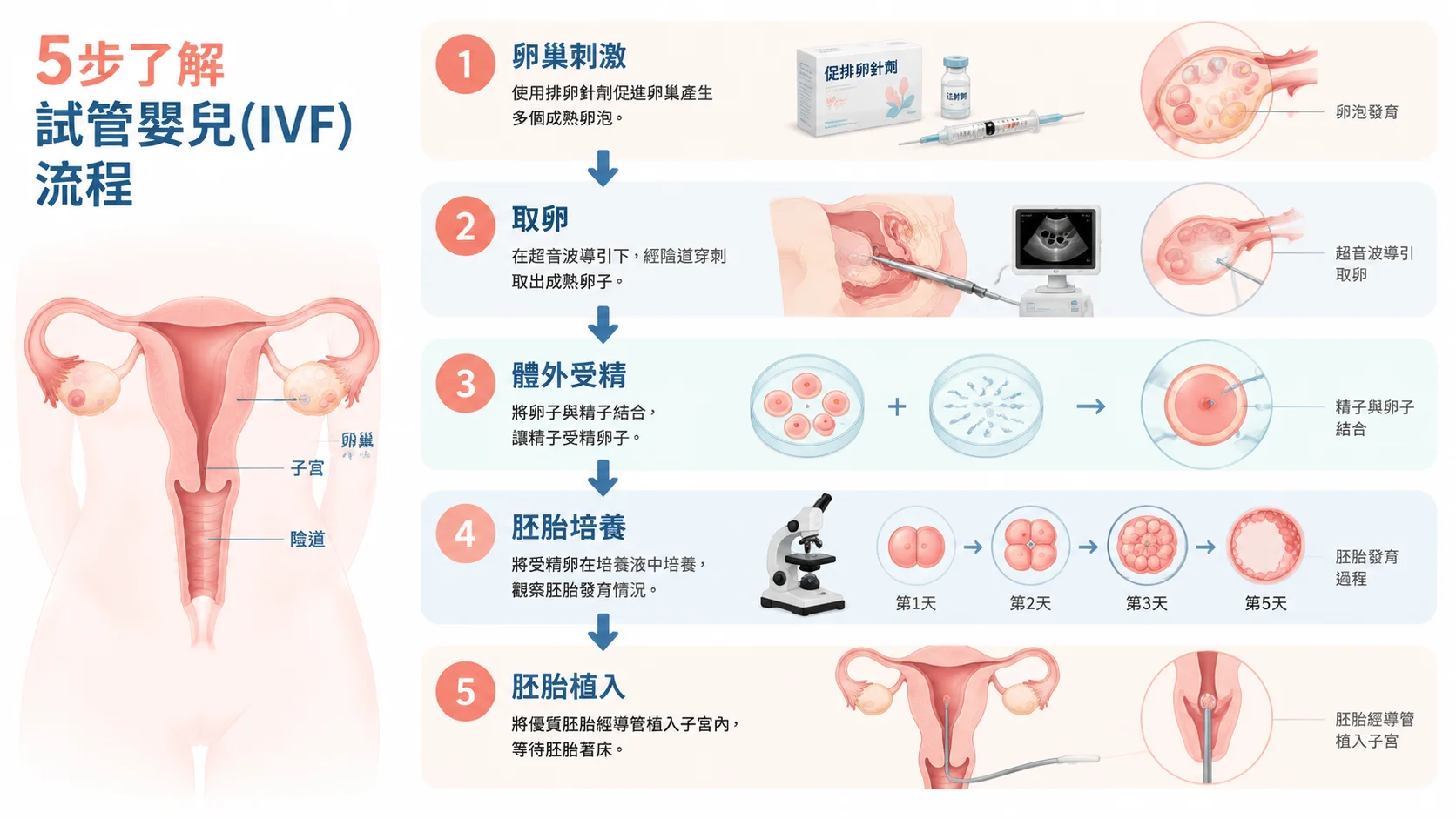
IVF is a five-stage cycle — stimulation, retrieval, fertilization, culture, transfer — that takes about 4-6 weeks from start to transfer.
- Ovarian stimulation — Hormone injections for 10-14 days grow multiple follicles at once
- Egg retrieval — A 20-30 minute needle procedure under anesthesia, guided by transvaginal ultrasound
- Fertilization — Eggs and sperm meet in a culture dish, or a single sperm is injected into each egg (ICSI)
- Embryo culture — Embryos develop in the laboratory for 3-6 days
- Embryo transfer — 1-2 healthy embryos are placed into the uterus through a thin catheter
Why Do Three Terms for the Same Treatment Still Exist?
Each term survives because it serves a different audience — clinics, families, journalists, and search engines each default to a different label.
| Setting | Term Usually Used | Why |
|---|---|---|
| Hospitals and doctors | IVF / in vitro fertilization | Precise, standardized medical terminology |
| Everyday conversation | Test tube baby | Easy to understand, widest public recognition |
| Chinese-language media | 试管婴儿 (test tube baby) | Reader familiarity and high recognition |
| Academic literature | In vitro fertilization / IVF | Standardized expression |
| Search engines | Test tube baby / IVF | Different user search habits |
| Medical travel consultations | IVF | Universally understood across borders |
In any clinic today, “IVF” is the universal standard — if you are considering treatment abroad, using the term “IVF” will make every conversation easier.
Is IVF a Single Technique?
No — “IVF” is an umbrella covering several distinct techniques chosen for specific diagnoses, and outcomes depend mainly on age. US clinics report every cycle into one public database, and the SART CORS national summary for 2023 gives live births per intended egg retrieval across all transfers from that retrieval:
| Age | Live Births per Intended Retrieval, All Transfers (2023) |
|---|---|
| Under 35 | 53.2% |
| 35-37 | 39.9% |
| 38-40 | 26.2% |
| 41-42 | 13.2% |
| Over 42 | 4.1% |
Because that metric credits every transfer from one retrieval, the rate for any single transfer is lower; the CDC’s annual ART report publishes per-transfer and per-clinic figures alongside it.
Within the IVF family, three branches are often labeled — inaccurately — as “generations”:
| Technique | Common Nickname | When It Is Used |
|---|---|---|
| Conventional IVF | ”First-generation” | Egg and sperm fertilize together in the dish; mainly for female factor infertility |
| ICSI (intracytoplasmic sperm injection) | “Second-generation” | A single sperm is injected into each egg; for severe male factor or prior fertilization failure |
| PGT (preimplantation genetic testing) | “Third-generation” | Embryos are screened for chromosomal or genetic conditions before transfer; for advanced age, recurrent miscarriage, or inherited disease risk |
These are not upgrades of one another — each has its own medical indication. Our PGT genetic screening guide breaks down the differences in detail.
Do Test Tube Babies Grow Up Differently? Five Myths Checked
Decades of evidence collected since 1978 have settled the five most common misconceptions about IVF.
- Myth 1: The baby grows in a test tube. Fertilization and the first 3-6 days happen in a dish; the entire pregnancy then unfolds inside the uterus.
- Myth 2: IVF children differ from naturally conceived children. A systematic review and meta-analysis of IVF and ICSI singletons found childhood growth in line with naturally conceived peers PMID 30168249, and a 2022 review of neurodevelopmental follow-up from ages 2 to 18 reported comparable outcomes, attributing most observed differences to subfertility, multiple pregnancy and gestational age PMID 36291447.
- Myth 3: IVF and artificial insemination are the same. IUI places sperm directly into the uterus and fertilization happens inside the body; IVF fertilizes the egg outside it. See our IUI vs. IVF comparison guide.
- Myth 4: IVF always means twins. Clinics transfer fewer embryos than they used to: in China’s national registry the average number of embryos transferred fell year by year from 2013 to 2016, and the multiple pregnancy rate in PGD/PGS cycles dropped from 30.5% to 1.7% PMID 33042000.
- Myth 5: “Second” and “third-generation” IVF are better versions. The generation labels are folk terminology: conventional IVF addresses female factor, ICSI addresses male factor, and PGT screens genetics — they solve different problems.
What Terms Will You Hear in a Fertility Clinic?
Clinic documents, media reports, and patient forums use different labels for the same procedures. This glossary maps the common Chinese-patient terms to the standard English terminology your doctor will use.
| Common Term | Standard English Term | Meaning |
|---|---|---|
| ”Test tube baby” (试管婴儿) | IVF / in vitro fertilization | Umbrella term for all lab fertilization treatments |
| ”First-generation” | Conventional IVF | Egg and sperm combine naturally in the dish |
| ”Second-generation” | ICSI | 1 sperm injected into 1 egg, mainly for male factor |
| ”Third-generation” | PGT | Genetic screening of embryos before transfer |
| Artificial insemination | IUI | Sperm placed in the uterus; fertilization happens inside the body |
| Stimulation | Ovarian stimulation | Hormone injections that grow multiple follicles |
| Transfer | Embryo transfer | Placing an embryo into the uterus |
What Does Treatment Look Like in Practice? Three Patient Stories
Three anonymized cases from Chinese clinics show how the same “IVF” label covers very different paths. These cases are anonymized summaries based on real patient experiences.
Case 1: One Cycle at 34 — Shanghai
Ms. Wang, 34, had both fallopian tubes blocked; one IVF cycle in Shanghai (about RMB 45,000) led to a healthy birth at 35.
Ms. Wang, 34 — bilateral tubal blockage. After two years of trying, testing showed both fallopian tubes were blocked. One IVF cycle at a Shanghai fertility center cost about RMB 45,000 (roughly US$6,500) including stimulation drugs, and a single blastocyst transfer led to a healthy birth at 35. “I grew up hearing ‘test tube baby’ on TV and never thought it would be me,” she says.
Case 2: Two Transfers at 39 — Shenzhen
Ms. Zhang, 39, succeeded on a second IVF cycle in Shenzhen for unexplained infertility, at a total cost of about RMB 90,000.
Ms. Zhang, 39 — unexplained infertility. Three years of testing with her husband found no clear cause. Her first transfer failed to implant; a second cycle with a modified protocol plus PGT-A screening succeeded. The two cycles cost about RMB 90,000 (roughly US$13,000) in total.
Case 3: ICSI for Severe Male Factor at 36 — Chengdu
Ms. Liu, 36, solved severe male factor infertility with one ICSI cycle in Chengdu for about RMB 55,000.
Ms. Liu, 36 — husband’s very low sperm count. His results pointed the doctor straight to ICSI — what Chinese clinics call “second-generation IVF.” One IVF+ICSI cycle fertilized and transferred successfully for about RMB 55,000 (roughly US$8,000). “I always assumed the problem was mine,” she says. “The tests showed it was male factor, and second-generation IVF solved it.”
FAQ
Q: Are “test tube baby” and IVF the same thing?
Yes — completely. “Test tube baby” is the popular nickname created by media coverage of the first IVF birth in 1978, while IVF (in vitro fertilization) is the medical term.
There is no scientific or practical difference.
Q: Is IVF better than artificial insemination, or IUI?
They suit different situations. IUI costs about RMB 3,000-8,000 per cycle but succeeds only 10-20% of the time; IVF costs RMB 30,000-80,000 in China with success rates around 40-60%.
The right choice depends on your diagnosis and age.
Q: What is the difference between 1st, 2nd, and 3rd-generation IVF?
First-generation (conventional IVF) lets sperm and egg combine in the dish and suits female factor infertility. Second-generation (ICSI) injects 1 sperm into 1 egg for male factor infertility.
Third-generation (PGT) screens embryos genetically for inherited disease or recurrent miscarriage. They address different problems — they are not upgrades.
Q: How much does IVF cost?
At public hospitals in China a cycle runs about RMB 30,000-80,000, while private clinics charge RMB 80,000-150,000. Thailand is roughly RMB 80,000-120,000 and the United States about RMB 150,000-250,000.
See our full IVF cost guide for a country-by-country breakdown.
Q: Can I choose my baby’s sex with IVF?
PGT can reveal embryo sex, but non-medical sex selection is strictly banned in China. It is legal in the United States, Thailand, and Mexico — where cycles cost roughly RMB 150,000-250,000 and RMB 80,000-120,000 respectively — which is one reason patients travel abroad for treatment.
Q: Can IVF succeed on the first try?
Yes — under the 2023 SART national summary, women under 35 have a 53.2% chance of a live birth per egg retrieval once all transfers from that retrieval are counted, though many patients still need 2-3 cycles to reach a pregnancy.
One Technology, Three Names
“Test tube baby,” “IVF,” and “in vitro fertilization” all describe the same technology — the one that has helped build an estimated 9.8 to 13 million families over the four decades since 1978 PMID 39947276. Knowing which term belongs in which setting simply makes your research and every conversation with a doctor smoother.
If you are exploring treatment, compare vetted centers in our global fertility clinic directory or contact the ProIVF team for personalized guidance on clinics and treatment plans.
Last updated: July 1, 2026. This article is for general education only and does not constitute medical advice. IVF costs, success rates, and legal rules vary by country and individual circumstance; consult a licensed fertility specialist before making treatment decisions.
Content Authorship
Written by the ProIVF Medical Editorial Team and reviewed by the ProIVF Medical Advisory Board, based on ASRM patient materials, the ICMART world reports, the SART CORS and CDC registries, and the Chinese Society of Reproductive Medicine registry report.
Sources
- Adamson GD, et al. Fertil Steril 2025;124(1):40-50 PMID 39947276
- Baker VL, et al. ICMART world report, cycles 2017-2018. Hum Reprod 2025;40(6):1110-1126 PMID 40239109
- Hu L, et al. ART in China, CSRM reporting system 2013-2016. Front Endocrinol 2020;11:458 PMID 33042000
- Bay B, et al. Childhood growth of IVF and ICSI singletons. BJOG 2019;126(2):158-166 PMID 30168249
- Perros P, et al. Neurodevelopmental outcomes after assisted reproduction. Children (Basel) 2022;9(10) PMID 36291447
- Society for Assisted Reproductive Technology — SART CORS National Summary Report
- Centers for Disease Control and Prevention — ART success rates
- American Society for Reproductive Medicine — asrm.org