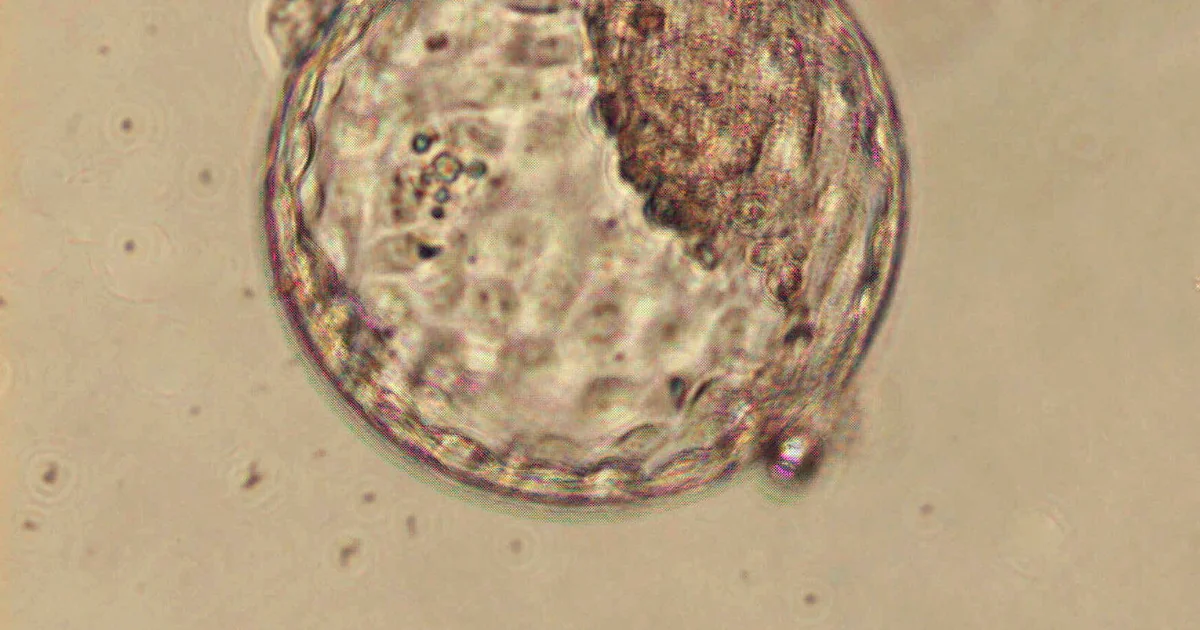
Yes — two sperm can enter one egg, and when they do the resulting zygote (the fertilised egg) carries three sets of chromosomes instead of two. Embryologists see it the next morning as a third pronucleus, the small round nucleus each sperm leaves behind before genetic material merges.
A zygote with two pronuclei (2PN) is normal; one with three (3PN) is almost never transferred. The reason is the extra chromosome set, triploidy, which accounts for about 1–2% of all conceptions. Most of those end in early miscarriage.
This guide is compiled by the ProIVF editorial team from peer-reviewed embryology and reproductive medicine literature, then reviewed by our medical advisory board.
It explains the block that normally stops a second sperm, and what happens when it fails. It also covers how often that occurs in IVF versus ICSI, and which changes are actually evidence-based.
Can Two Sperm Fertilize One Egg in a Natural Cycle?
It is possible, and in humans it is rare but not unknown. What matters is that the egg does try to stop it, twice.
What Normally Blocks a Second Sperm?
Fusion with the first sperm triggers the oocyte’s cortical granules (secretory vesicles packed just under its membrane) to empty their contents outward. A 2020 review in Molecular Reproduction and Development from Karolinska Institutet lists what they release onto the egg coat: proteases, glycosidases, lectins and zinc.
“Fertilization by more than one sperm causes polyploidy, a condition that is generally lethal to the embryo in the majority of animal species. To prevent this occurrence, eggs have developed a series of mechanisms that block polyspermy at the level of the plasma membrane or their extracellular coat.” — Fahrenkamp, Algarra and Jovine, Molecular Reproduction and Development, 2020
Two blocks, then: the membrane itself becomes refractory. The zona pellucida (the glycoprotein shell around the egg) is chemically altered and hardened, so additional sperm can no longer bind and penetrate it. When either step is incomplete, more than one sperm contributes genetic material. That is polyspermy, and in the lab it usually surfaces as a third pronucleus.
What Does a 3PN Zygote Look Like?
Three pronuclei mean 69 chromosomes rather than 46. The usual zygote combinations are 69,XXX, 69,XXY and 69,XYY, and the clinical genetics literature on triploid pregnancies divides them by origin:
| Type | Where the extra set came from | Typical mechanism |
|---|---|---|
| Diandric (paternal) | Two sperm, or one sperm that duplicated | Polyspermy at insemination |
| Digynic (maternal) | The egg kept a second set | Failure to extrude the second polar body |
Paternal-origin triploidy is the one linked to a partial hydatidiform mole, a mass of abnormal placental tissue. That triploidy review also notes that the serious maternal complications cluster with paternal origin.
Those are gestational trophoblastic neoplasia, hyperthyroidism, hypertension and preeclampsia. Digynic conceptions are more likely to be recognised later, and are not the same clinical problem.
How Often Does Polyspermy Happen in IVF?
Between about 7% and 9% of zygotes in conventional IVF, and well under 1% after ICSI. That gap is the number worth remembering.
What Have Large Series Measured?
| Setting | Polyspermy / 3PN rate | Source |
|---|---|---|
| Conventional IVF, cumulus removed at 6 h (565 cycles) | 7.48% | J Assist Reprod Genet 2011 |
| Conventional IVF, cumulus removed at 20 h (635 cycles) | 9.22% | J Assist Reprod Genet 2011 |
| ICSI, micro-3PN (183 of 75,903 injected eggs) | 0.24% | J Assist Reprod Genet 2023 |
| Early IVF programme, 3+PN of fertilised oocytes | 10% | Ann N Y Acad Sci 1985 |
The 2011 study covered 1,200 cycles with normal fertilisation near 65% in both arms. Both stripped the cumulus cells that cushion each egg at a fixed hour, so the two polyspermy figures sit on comparable cohorts.
The 1985 figure comes from an early generation of the technique: 585 oocytes in 180 patients. The sperm doses used for insemination then were far higher than most laboratories use now.
Why Does ICSI Almost Remove the Problem?
Because a single sperm is injected into each egg, so no competition at the zona pellucida happens at all. That is the mechanism behind the 0.24% figure, and it is why ICSI is standard when fertilisation fails or comes in very low.
ICSI does not reduce the rate to zero, because an egg can still retain a second polar body (the small packet of maternal chromosomes it was meant to discard). A third pronucleus is therefore not automatically a second sperm.
Was It Really Two Sperm?
Not always, and this is the question worth pursuing with your embryologist before you assume the worst about your eggs or your partner’s sperm.
After ICSI, a third pronucleus has two candidate explanations: an extra sperm, or a retained second polar body. A FISH study of tripronuclear zygotes after ICSI answered that question with probes that tag the chromosomes themselves instead of judging shape. It found 36% of zygotes classified as 3PN on morphology were in fact diploid, carrying the normal two sets.
The same study named that retained polar body as the main cause of triploidy after ICSI. Morphology alone therefore misclassifies roughly a third of what the lab marks as 3PN in injected eggs.
That does not make them transferable, since no lab can verify ploidy by eye. It does explain why some clinics culture a subset of abnormal-looking zygotes rather than discarding every one.
Will a 3PN Embryo Ever Be Normal?
Rarely, and measurably less often than embryos from normally fertilised eggs.
The 2023 ICSI series used micro-3PN for a third pronucleus visibly smaller than the other two. Of the micro-3PN embryos that reached biopsy, 27.5% (11 of 42) came back euploid.
Euploid means a normal chromosome count, and PGT-A is the test that reads it from cells taken at the blastocyst stage, around day five. For 2PN-derived embryos the euploid figure was 51.4% (12,301 of 23,923). The difference narrowly missed statistical significance (p = 0.06) but was clinically stark.
Four of those euploid micro-3PN embryos were transferred in single-embryo frozen cycles, producing one live birth and one ongoing pregnancy.
A 2026 cohort of 150 patients reports the harder version. Of 508 blastocysts, 44 (8.7%) had come from 3PN zygotes and 13 (2.6%) from 1PN, where a single pronucleus leaves the count equally unreadable. PGT-A was run on 23 of the 3PN-derived embryos, and all tested blastocysts were aneuploid (an abnormal chromosome count), so none were transferred.
Where 3PN blastocysts were transferred without genetic testing, the single pregnancy came from a combined transfer alongside a normally fertilised embryo.
The two studies differ in what they cultured, namely a small extra pronucleus after ICSI or full 3PN morphology. That difference is the honest boundary of the evidence: a micro-3PN zygote has a documented, minority route to a euploid embryo; a clean 3PN zygote after conventional insemination does not.
Does a High 3PN Rate Mean My Cycle Went Badly?
It means something about that cohort of eggs, and the two large studies point in opposite directions on how much to read into it.
What Raises the Chance of 3PN?
A 2025 study of 1,250 donor-sperm IVF transfer cycles in women aged 35 or under found two independent associations with 3PN. Both sit on the stimulation side: peak oestradiol on the hCG trigger day (OR 1.16, 95% CI 1.12–1.19) and the number of oocytes retrieved (OR 1.08, 95% CI 1.05–1.11).
The same study compared cycles with any 3PN zygotes against cycles with none. Ongoing pregnancy (p = 0.033) and live birth rates (p = 0.009) came out lower, and the miscarriage rate higher (p = 0.026).
A retrospective study of 508 donor-sperm IVF cycles quantified what a heavy 3PN share costs. Comparing cycles with no 3PN, 1–25% and more than 25%, normal fertilisation ran 68.4%, 66.3% and 46.4%, and day-3 grade I+II embryos 41.2%, 38.6% and 25.8%.
Implantation rate (the share of transferred embryos that establish a pregnancy) fell across the same three groups: 52.1%, 50.8% and 45.4% (p = 0.026). Pregnancy rate dropped to 55.6% in the highest group, but not significantly (p = 0.266).
Is It Your Eggs?
Sometimes the reading is the reverse of what patients expect. The 2024 analysis of 1,428 conventional IVF cycles counted eggs whose nuclei had not finished maturing by day 1, and the highest share sat in cycles with no 3PN zygotes (23.8%).
That immature share fell as the 3PN proportion rose (p < 0.001). Cycles with a low 3PN share then had a higher clinical pregnancy rate than those with none, with no difference in live birth rate between the low- and high-proportion groups.
The authors’ interpretation is that a few 3PN zygotes indicate a more mature cytoplasmic state across the cohort, not a defective one.
So: high oestradiol, more eggs retrieved, and a cohort that matured well all correlate with more 3PN. Age-related egg quality is not the driver. In the 1985 fertilisation series, polyspermy was unrelated to patient age across 20–45 years and unrelated to the stimulation method used.
What About the Sperm Sample Itself?
Sperm dose is the one variable the laboratory controls directly. In the 1985 series, inseminating with 0.5–0.8, 1.0 or 1.5–2.0 million sperm per oocyte produced polyspermy in 6%, 20% and 32% of cases respectively.
Immature oocytes in that series polyspermied at 32%, against 6% for mature ones. That dose-response is why standard insemination concentrations are set low, and why reading a semen analysis is a different question from deciding how many sperm to add.
Can Polyspermy Be Prevented Next Cycle?
One intervention has randomised evidence, and it does not do what patients assume.
Does Shortening Sperm Exposure Help?
An updated meta-analysis of 11 randomised trials compared brief co-incubation (1–6 hours) with long co-incubation (16–24 hours). For polyspermy the odds ratio was 0.80 with a 95% confidence interval of 0.48–1.33 — a trend, not a demonstrated reduction.
Normal fertilisation was significantly lower with brief exposure (OR 0.89, 95% CI 0.80–0.99). Implantation, by contrast, came out higher (OR 1.97, 95% CI 1.52–2.57), as did ongoing pregnancy (OR 2.18, 95% CI 1.44–3.29).
Live birth showed no difference (OR 1.09, 95% CI 0.72–1.65). Shortening exposure is a legitimate protocol question for other reasons, but nobody should be told it will stop polyspermy.
What Do Clinics Actually Change?
Switching to ICSI, adjusting insemination concentration, and reviewing trigger timing are the levers. If your stimulation protocol produced very high oestradiol and many eggs, a mild protocol is a reasonable discussion.
Calcium ionophore and other oocyte-activation techniques serve the opposite problem, an egg that will not activate at all. Those are covered in our calcium ionophore guide.
What If Nothing Fertilised Normally Instead?
Then the question inverts. In the 2011 study, 80 cycles received early rescue ICSI (injecting sperm into eggs that still looked untouched at six hours) and reached a clinical pregnancy rate of 51.43%.
Three cycles had late rescue ICSI at 20 hours, and none resulted in pregnancy. Timing of the day-1 check is what makes rescue possible, which is why the lab’s 16–18 hour fertilisation assessment exists at all.
Three Day-1 Reports, Three Different Answers
These cases are composites built from typical IVF presentations. Names and amounts are invented to illustrate scenarios, not identifiable records, and the costs are indicative out-of-pocket estimates rather than quotes.
Hannah, 33, Bristol: Eleven Eggs, Two 3PN
Hannah had unexplained infertility for four years. Eleven eggs were retrieved, nine mature, and the day-1 call was seven normally fertilised and two with three pronuclei.
The two 3PN zygotes were discarded. Five embryos reached day 5, graded as two good and one fair. A single blastocyst transfer in the same cycle resulted in a daughter born at 39 weeks. Self-paid total, including medications: about £4,100.
“The embryologist said two out of nine was completely ordinary,” she recalled. “I had already written myself a speech about whose fault it was.”
Elif, 36, Istanbul: Nine of Twenty-One Zygotes With Three Pronuclei
Elif’s first cycle used conventional insemination on 21 mature eggs. Nine zygotes carried three pronuclei the next morning, and only four looked normally fertilised.
Two embryos developed, neither good enough to freeze, and no transfer was possible. For the next cycle her team switched to ICSI.
In the second cycle none of the 12 zygotes showed three pronuclei. Four reached blastocyst, two were euploid on PGT-A, and her son was born at 38 weeks after the first of those transfers. Self-pay across both cycles: roughly €11,500.
“What helped most was being told the number changed,” she said. “Not being told it was my age.”
Grace, 34, Dublin: Culture Instead of Discard
Grace had diminished ovarian reserve, a low remaining egg supply, and one egg retrieved in her first cycle. It fertilised as a micro-3PN zygote, and the lab offered to culture it rather than discard it.
The embryo reached blastocyst and biopsy, and PGT-A reported euploid. Transfer produced a pregnancy that did not continue. A second cycle, with two eggs and both normally fertilised, gave a euploid blastocyst and a daughter born at 37 weeks. Self-pay: about €5,600 across the two cycles.
The couple still asks what the first transfer cost them in time, and without resentment. “We lost four months on an embryo with a 27.5% chance,” Grace said. “Knowing that number then would have changed how we planned it.”
FAQ
Q: Can two sperm fertilize one egg?
Yes — the egg’s two blocks, membrane change and zona hardening, fail sometimes, and a second sperm then leaves a third pronucleus. In conventional IVF cohorts it shows up in 7.48% and 9.22% of zygotes depending on laboratory protocol, an uncommon event rather than a rare catastrophe.
Q: What happens if two sperm fertilize an egg?
The zygote carries 69 chromosomes instead of 46, and triploidy of this kind accounts for about 1–2% of all conceptions. Most such pregnancies end in early miscarriage; paternally-derived ones are the cases linked to a partial mole, hypertension, hyperthyroidism and gestational trophoblastic neoplasia.
Q: Is a 3PN embryo abnormal?
Usually, but the label is imperfect: a FISH study of injected eggs found that 36% of zygotes classed as 3PN on shape alone were in fact diploid. A 3PN marking means the lab cannot use that zygote, not proof that two sperm entered it.
Q: Why don’t clinics transfer 3PN embryos?
Because the odds are poor and other embryos usually exist: in one large ICSI cohort 27.5% of biopsied micro-3PN embryos were euploid, against 51.4% for normally fertilised ones. In a 2026 cohort all 23 PGT-A-tested 3PN blastocysts were aneuploid, and where such embryos were transferred untested, pregnancies are reported but uncommon.
Q: Does polyspermy mean my eggs are poor quality?
No: across 1,428 conventional IVF cycles immature eggs were most frequent in cycles with no 3PN zygotes (23.8%), and became less common as the 3PN share rose. The variables tied to 3PN are high oestradiol on trigger day (OR 1.16) and more eggs retrieved (OR 1.08), not egg quality.
Q: Will it happen again in my next cycle?
Not necessarily, and not by the obvious route: brief versus long insemination gave a polyspermy OR of 0.80 (95% CI 0.48–1.33), not a significant reduction. Brief exposure also lowered normal fertilisation (OR 0.89), while ICSI has the mechanistic basis on its side: 183 of 75,903 injected eggs showed micro-3PN.
Q: Is ICSI better than IVF for fertilisation?
For the fertilisation event itself, largely yes: 7.48% and 9.22% of zygotes polysperm in the two conventional IVF arms, against 0.24% after ICSI. The trade is micromanipulation, and our IVF versus ICSI comparison and fertilisation timeline set out what each route changes.
Q: Can polyspermy be detected before transfer?
PGT-A needs cells from an embryo that has reached blastocyst, as our genetic screening guide explains, so nothing is testable on day 0. That is why the day-1 pronuclear count decides what gets cultured, and why only 11 of 42 biopsied micro-3PN embryos in one ICSI series were euploid.
Where This Leaves Your Cycle
Ask three questions at your next review:
- How many zygotes fertilised normally, and what the 3PN count was.
- Whether the lab cultures abnormally fertilised zygotes when no 2PN embryo exists.
- What changes are planned for insemination concentration, insemination timing, or a switch to ICSI.
If recurrent pregnancy loss is part of your history, the recurrent loss guide covers where genetic causes fit.
You can compare embryology laboratories that publish their fertilisation and blastulation rates in our hospital directory. Or send your day-1 and day-5 reports through our contact page, and we will help you read them.
This article is educational and does not replace individualised medical advice. Decisions about discarding or culturing abnormally fertilised zygotes belong to a clinician and embryologist who can see your own laboratory data.
Every figure here is linked to its PubMed record. The ProIVF medical editorial team compiled this guide, and the ProIVF Medical Advisory Board reviewed it. Read about the team on our about page.
Last updated: October 1, 2026