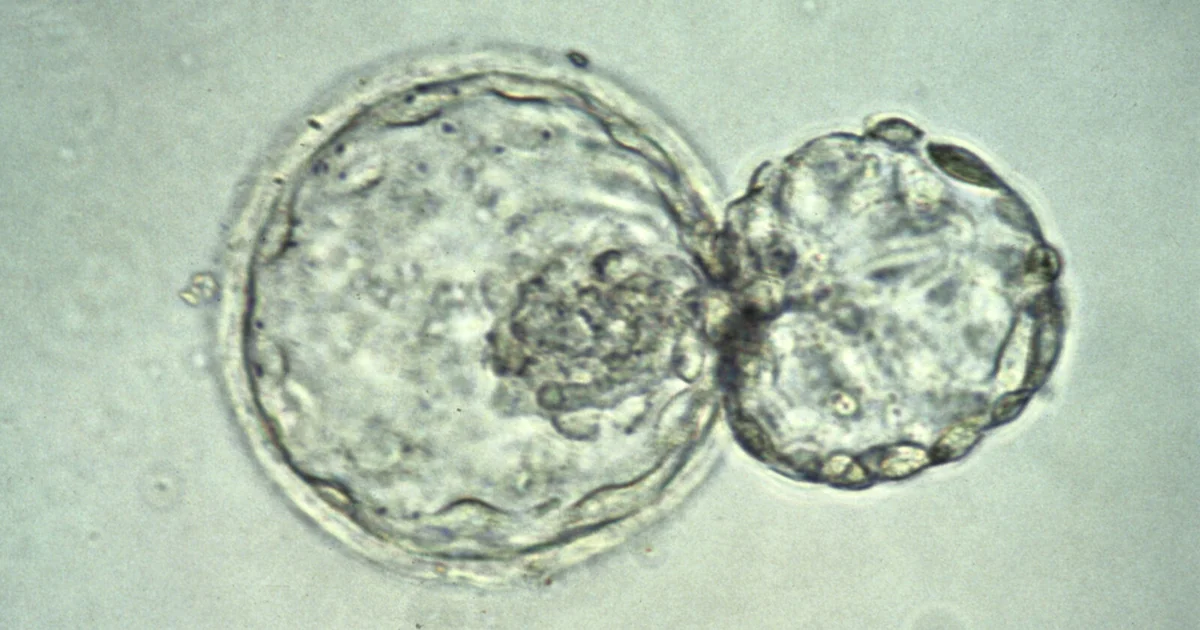
What Exactly Counts as a Day 7 Embryo?
A day 7 embryo is a blastocyst that hatches late: it reaches the expansion stage needed for biopsy or transfer on day 7 after insemination instead of day 5 or day 6. Optimal embryos reach the blastocyst stage about 116 ± 2 hours after insemination, so a day 7 blastocyst runs roughly one to two days behind that schedule — Abdala et al., Zygote, 2023.
The category is genuinely rare. A 2025 multicenter study analyzed 6,924 blastocysts in Mexico and found only 101 of them (1.5%) biopsied on day 7, plus 2 on day 8 — Abarca-Rodríguez et al., JARG, 2025. A 2018 Los Angeles series put day 7 at 1.7% of 2,132 biopsied blastocysts — Kaing et al., JARG, 2018. A review from Reproductive Medicine Associates of New Jersey puts day 7 blastocysts under 10% of embryos usable for transfer — Vessa & Franasiak, Current Opinion in Obstetrics and Gynecology, 2025.
Two things made day 7 a clinical question at all. Extended culture systems keep embryos viable past the classic five-day window, and vitrification — a flash-freezing technique that avoids ice-crystal damage — lets a lab freeze a day 7 blastocyst and transfer it in a later cycle. That removes the need to rush a fresh transfer.
Are Day 7 Embryos More Likely to Be Chromosomally Abnormal?
Yes, and the effect is consistent across every center that has measured it. Euploidy — a chromosomally balanced result on PGT-A, the preimplantation genetic test that counts an embryo’s chromosomes — falls as blastulation takes longer: 41.6% to 67.7% on day 5, 32.7% to 52.1% on day 6, and 27.7% to 43.1% on day 7, depending on the cohort.
| Study (year, center) | Day 5 euploid | Day 6 euploid | Day 7 euploid | embryos analyzed |
|---|---|---|---|---|
| Tiegs 2019, single US center | 67.7% | 52.1% | 43.1% | 9,297 usable |
| Kaing 2018, Los Angeles | 49.5% | 36.5% | 32.9% | 2,132 biopsied |
| Abarca 2025, multicenter Mexico | 41.6% | 32.7% | 27.7% | 6,924 analyzed |
The odds ratios tell the same story in one large dataset. In the Tiegs series of 2,586 patients, day 5 versus day 7 embryos carried an odds ratio (OR — under 1.00 means lower odds) of 0.56 for euploidy, with a 95% CI of 0.46–0.69 and P < 0.001; day 6 versus day 7 was OR 0.81 (95% CI 0.67–0.99, P = 0.036) — Tiegs et al., Human Reproduction, 2019.
Why the spread between studies rather than one clean number? Age mix and biopsy policy explain most of it. The Tiegs figures report “usable blastulation day” across all ages. Abarca’s 41.6% day 5 baseline comes from a Mexican cohort with a different age profile, and its denominator excludes a 5.6% amplification-failure rate.
Does Slow Development Cause the Aneuploidy, or Reveal It?
Not settled, and one large Chinese cohort pushes directly against the simple reading: aneuploidy, a wrong chromosome count, tracked embryo appearance there rather than the calendar. In 4,172 blastocysts from 941 PGT-A cycles at Nanjing Women’s Hospital, euploidy was associated with blastocoel expansion, inner cell mass grade (the cell group that becomes the fetus) and trophectoderm grade (the outer layer that becomes the placenta) — but not with developmental day — Chen et al., Reproductive Sciences, 2025.
“Aneuploidy increases with increasing duration of blastulation, but if blastocyst morphologic quality and endometrial-embryo asynchrony are controlled for, euploid Day 7 embryos have similar sustained implantation as compared to Days 5 and 6 euploid blastocysts.” — Tiegs, Sun, Patounakis & Scott, Human Reproduction, 2019
That sentence is the hinge of the whole topic: day of biopsy and morphology are entangled, and studies that do not separate them disagree with studies that do.
What Is the Actual Success Rate of a Day 7 Transfer?
For a chromosomally normal (euploid) day 7 blastocyst transferred in a frozen cycle, published rates land near half of the day 5 numbers. In the euploid cohorts below day 7 runs 22.2% to 52.6%, against 52.5% to 68.9% on day 5, and the range stays wide because day 7 samples are small.
| Outcome by biopsy day, single embryo transfer | Day 5 | Day 6 | Day 7 | Source |
|---|---|---|---|---|
| Sustained implantation rate | 68.9% (95% CI 66.0–71.6) | 66.8% (63.8–69.7) | 52.6% (35.8–69.0) | Tiegs 2019 |
| Live birth rate | 52.5% | 43.2% | 22.2% | Abarca 2025 |
| Ongoing pregnancy rate | 56.0% | 45.3% | 11.1% | Abdala 2023 |
| Clinical pregnancy rate, literature range | — | — | 16.7–52.6% | Vessa & Franasiak 2025 |
Read the columns together: the day 7 penalty is real but rests on small samples, because only 229 day 7 embryos were euploid in the Tiegs series and far fewer reached transfer. Tiegs therefore found no statistically significant day 5 versus day 7 difference (OR 0.67, 95% CI 0.32–1.41, P = 0.29).
The smaller Abdala series lands at the other end of the range, at 11.1%. Its adjusted odds for ongoing pregnancy with a day 7 blastocyst were OR 0.23 (95% CI 0.08–0.62, P = 0.004) — Abdala et al., Zygote, 2023.
The review that pooled these studies lands between them: clinical pregnancy rates for euploid day 7 embryos of 16.7% to 52.6%, and live birth rates of 21.5% to 46% — Vessa & Franasiak, 2025.
National reporting does not settle it: the 2026 audit of ART outcome reporting by the US Centers for Disease Control and Prevention covers clinic-level success rates for all embryo stages but publishes no day 7 breakdown. That is why the peer-reviewed cohorts above are the best available evidence.
Why Do Two High-Quality Studies Disagree So Strongly?
Because day 7 embryos are not one population. Three mechanisms explain most of the gap between the 52.6% implantation figure and the 11.1% ongoing pregnancy figure.
Morphology is the first confounder: in Abdala’s series, 83.3% of day 7 blastocysts were poor quality by Gardner scoring (the standard blastocyst grading scale), against 12.5% of day 5 embryos. Poor-quality blastocysts independently cut ongoing pregnancy on their own (OR 0.33, 95% CI 0.24–0.45, P < 0.001). Once Tiegs adjusted his analysis for blastocyst morphology and maternal age, the day 7 penalty largely disappeared.
Maternal age tracks the biopsy day: mean age in Abdala’s day 5, 6 and 7 groups was 33.2 ± 5.6, 34.4 ± 5.3 and 35.9 ± 5.2 years (P < 0.001). The day 7 group was already older before development speed entered the picture.
Cycle type matters: hormone-replacement frozen cycles, where progesterone and estrogen are given as medication rather than produced by a natural cycle, were independently worse than natural cycles in the same dataset (OR 0.70, 95% CI 0.56–0.88, P = 0.002). Higher BMI reduced the odds further, at OR 0.96 per unit (95% CI 0.94–0.98).
What Sample Size Hides
Only 36 day 7 transfer cycles were available to Abdala out of 1,527 frozen transfers, and 229 euploid day 7 embryos to Tiegs out of 9,297 usable blastocysts. A 22.2% live birth rate in a day 7 group counted in dozens of transfers, and a 52.6% implantation rate whose confidence interval spans 35.8% to 69.0%, express the same underlying uncertainty.
Should Your Lab Culture Embryos to Day 7?
For patients aged 38 and over, extending culture is often the difference between having an embryo to transfer and having none. It recovers blastocysts that a strict five-day deadline would have discarded, and it changes who reaches a transfer at all.
Abdala’s authors draw the practical conclusion directly: culturing to day 7 can increase ongoing pregnancy outcomes in patients aged 38 and over, because older patients are the group most likely to end up with day 7 biopsies — Abdala et al., 2023.
The trade-off is real. Embryos held to day 7 sit longer in culture, and a lab must decide at what point a not-fully-expanded blastocyst is frozen, biopsied, or dropped.
French data on slow development in fresh cycles points the other way for one specific situation. Among 1,093 single blastocyst transfers, fresh transfer of a fully expanded day 5 blastocyst produced significantly higher clinical pregnancy and live birth rates than any other strategy. A slowly developing day 5 blastocyst, at early stage B1–B2, also did better transferred fresh on day 5 than cultured to day 6 or frozen — Loubersac et al., Journal de Gynécologie Obstétrique et Biologie de la Reproduction, 2022.
| Situation | What the data support |
|---|---|
| At least one expanded day 5 blastocyst exists | Transfer or biopsy day 5 first; day 7 is a fallback, not a priority |
| Only slow embryos by day 6 | Extended culture to day 7 can still create a biopsy-able, freezable blastocyst |
| Euploid day 7 is your only embryo | A frozen single transfer is a legitimate option; expect roughly half the day 5 outcome |
| Age 38+ with no day 5/6 blastocyst | Day 7 culture is where most of your usable embryos may be found |
| Repeated failures with good-looking euploid embryos | Ask about endometrial and other factors, not just the biopsy day — why IVF fails with good embryos |
How Is a Day 7 Embryo Transferred?
In a frozen cycle the transfer window is set by the endometrium, not by the embryo’s birthday, so the 116 ± 2 hour blastulation clock stops mattering. That is the point Tiegs makes about asynchrony, meaning uterus and embryo falling out of step: vitrification removes the timing mismatch that penalizes a slow embryo in a fresh cycle — Tiegs et al., 2019.
Our frozen embryo transfer guide works through the scheduling logic, the progesterone start day and the gestational-age correction for a day 6 or day 7 blastocyst.
Two lab details change the conversation more than the calendar day does. The first is trophectoderm grade: an A-grade outer layer beat a C-grade layer for live birth in the Nanjing euploid cohort, at P = 0.024, and it was the only morphological parameter still linked to outcome. The second is whether the result was truly euploid rather than mosaic — an embryo whose cells all test chromosomally normal, versus a mix of normal and abnormal cells — a distinction covered in our guide to euploid embryos. For how grading happens in the first place, see embryo grading explained and the blastocyst development timeline.
Three Patient Paths
Three cycles, three different answers, all built on late blastocysts — day 7 euploidy runs 27.7% to 43.1% across published cohorts. Patient stories are shared with consent; names and identifying details have been changed to protect privacy, and all clinical figures reflect the sources cited above.
Grace, 38, Los Angeles — the only embryo was day 7: her long protocol produced three blastocysts, and all three expanded on day 7 rather than day 5. All were biopsied, one came back euploid, and her clinic froze it and scheduled a hormone-replacement transfer about nine weeks later.
She paid $28,500 for the retrieval, ICSI (a single sperm injected into a single egg), biopsy, vitrification and the first transfer, inside the $15,000–$30,000 range typical of US cycles. “My coordinator said the honest number was maybe half of what a day 5 embryo gives, and she would still transfer it,” she recalled. She delivered a healthy daughter at 39 weeks.
Lin, 35, Chengdu — day 6 first, day 7 as backup: in a China mainland cycle costing ¥58,000, two of her four blastocysts were usable on day 6 and one more appeared only on day 7. The day 6 embryos were biopsied first; the day 7 blastocyst was frozen without biopsy because her clinic’s policy required a clear morphological grade. “The embryologist told me the day 7 one looked fine but was late, and they would not throw it away,” she said. Her first transfer of a euploid day 6 embryo failed; the second, using the other day 6 embryo, resulted in a singleton pregnancy at 12 weeks.
Ana, 41, Miami — all three transfers used late embryos: at 41 she had one day 5, one day 6 and one day 7 euploid blastocyst out of eleven biopsied. She transferred in that order: day 5 did not implant, day 6 gave a chemical pregnancy (one that ends very early, before an ultrasound can confirm it), and day 7 implanted.
The day 7 embryo — the one she called “the last one in the tank” — reached live birth at 39 weeks’ gestation, after a cycle that cost $26,800 with a partial fertility-preservation insurance benefit. “Everyone talks about day 5 like it is the only real option,” she said. “My son came from the day they were going to discard.”
FAQ
Q: Is a day 7 embryo a bad embryo?
No, it is a late embryo rather than an abnormal one: 43.1% of usable day 7 embryos were euploid in the Tiegs dataset, roughly two in five. In Abarca’s series, day 7 euploid transfers still produced live births in 22.2% of cases.
Q: What is the success rate of a day 7 blastocyst transfer?
Expect a clinical pregnancy rate between 16.7% and 52.6%, and a live birth rate between 21.5% and 46%, for one euploid day 7 embryo. Where a clinic lands inside that spread depends on morphology grade and sample size, because day 7 transfers are counted in dozens rather than hundreds.
Q: Are day 7 embryos euploid less often than day 6?
Slightly. The largest single-center analysis put day 6 euploidy at 52.1% and day 7 at 43.1% (OR 0.81, 95% CI 0.67–0.99, P = 0.036), while a 2018 Los Angeles series found 36.5% and 32.9% and a 2025 multicenter study 32.7% and 27.7%.
Q: Should we biopsy day 7 blastocysts at all?
Yes, because biopsy is how you find the minority that test chromosomally normal: 27.7% to 43.1% came back euploid across three cohorts. The one French dataset on fresh cycles argues the opposite priority for simply slow day 5 embryos, namely transferring them fresh on day 5 rather than waiting.
Q: Does a day 7 embryo cause a mismatch with my uterus?
In a fresh cycle, yes, that is the asynchrony problem. In a frozen cycle the endometrium is prepared on its own schedule, which is why the day 7 penalty shrinks once morphology and age are controlled for in the Tiegs analysis of 2,130 euploid single-embryo transfers.
Q: What if day 7 is my only option?
Transfer it as a single embryo in a frozen cycle rather than skipping the cycle. Abdala’s team concluded that culture to day 7 can raise ongoing pregnancy outcomes specifically for patients aged 38 and over, the group most likely to have only late blastocysts.
Q: Do time-lapse incubators change the decision?
They change when you find out, not the biology, because continuous imaging flags expansion earlier and lets a lab plan a day 7 biopsy instead of discovering a late blastocyst at one evening check. The ceiling does not move: the best day 7 euploid rate reported is 43.1%, and trophectoderm grade still predicted live birth at P = 0.024.
Q: How much does adding day 7 culture cost?
Day 7 culture itself is not usually billed separately. The cost drivers are biopsy, PGT-A and vitrification, which sit inside the $15,000–$30,000 US cycle range and the ¥30,000–¥80,000 mainland China range described in our IVF cost breakdown.
What to Hold On to
Five conclusions the data support:
- Day 7 embryos are euploid about 28%–43% of the time, versus 42%–68% for day 5, across three independent cohorts totaling more than 18,000 biopsied or usable blastocysts.
- A euploid day 7 transfer is a real transfer: expect roughly half of a day 5 outcome — 22.2% to 52.6% depending on the series — not zero.
- Morphology explains most of the disagreement: in the Abdala series 83.3% of day 7 blastocysts scored poor quality, and when grade and maternal age are adjusted the day 7 implantation penalty loses statistical significance.
- Age decides who needs day 7: patients 38 and older are the group most likely to have only late blastocysts, which is the argument for extended culture.
- Freeze it, do not force a fresh transfer: vitrification removes the endometrial timing mismatch that penalizes an embryo running one to two days behind the optimal 116 ± 2 hour schedule.
Ask your clinic three questions before a cycle. What does their own day 5/6/7 split look like, do they biopsy day 7 blastocysts, and would a day 7 euploid embryo be transferred in your next planned cycle?
The American Society for Reproductive Medicine and the European Society of Human Reproduction and Embryology both publish patient-facing guidance on embryo culture and PGT-A, and clinics vary in policy more than the literature suggests. To compare labs that publish their own blastulation and PGT-A statistics, browse verified hospital profiles or contact the ProIVF team.
Euploidy and implantation figures in this article come from PubMed-indexed cohorts — Tiegs 2019, Kaing 2018, Abarca 2025, Abdala 2023, Chen 2025, Loubersac 2022 — and the pooled ranges from a 2025 narrative review.
About this article: Researched and written by the ProIVF Medical Editorial Team from PubMed-indexed cohort studies and a 2025 expert review on day 7 embryos, with AI-assisted tools used only for literature organization and initial drafting under editorial direction. Reviewed by the ProIVF Medical Advisory Board; our editorial standards are on our About page. ProIVF has no commercial relationship with any clinic, laboratory product or testing brand named here.
Last updated: October 13, 2026. Informational only, not medical advice: embryo culture day, biopsy policy and transfer decisions must be made with your own reproductive endocrinologist and embryologist, and every rate quoted here is population data that cannot predict an individual cycle.
Cover image: a human blastocyst mid-hatch, phase-contrast micrograph by K. Hardy, courtesy of Wellcome Collection, CC BY 4.0.