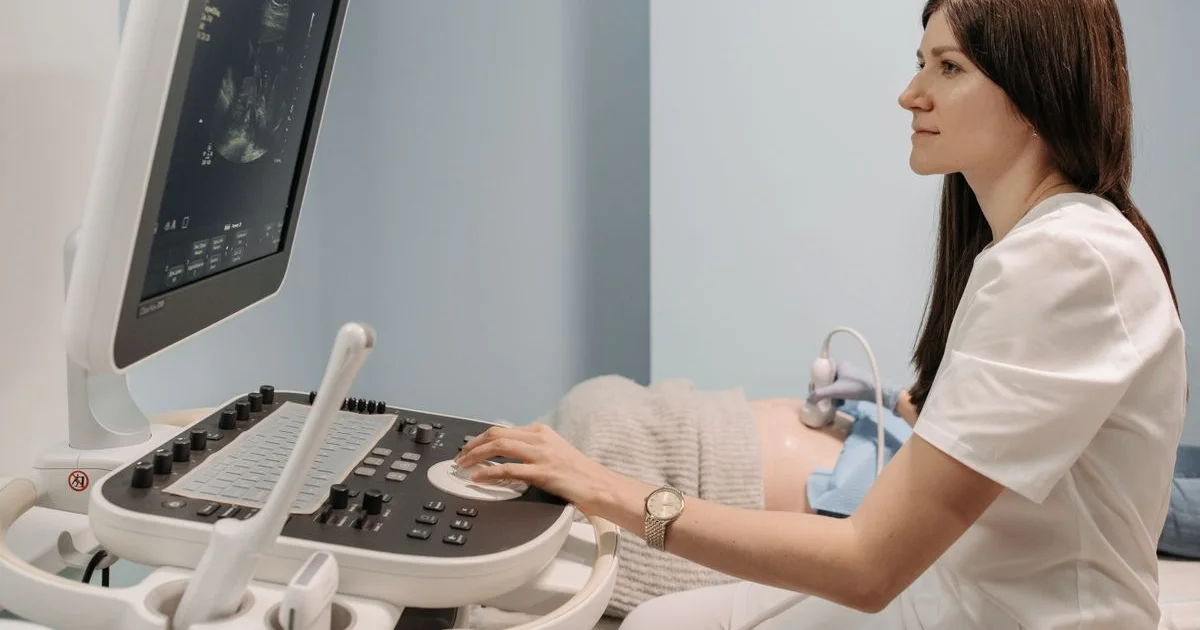
An embryo transfer is a 5-10 minute outpatient procedure performed with a speculum, a soft catheter and a transabdominal ultrasound — no anaesthetic, no incision, and usually no more discomfort than a smear test.
This article was researched and drafted by the ProIVF Medical Editorial Team from the randomized trials and guidelines cited inline, and reviewed before publication by the ProIVF Medical Advisory Board. We describe the procedure as clinics actually perform it, then separate the steps that change outcomes from the rituals that do not.
What happens during an embryo transfer?
The embryologist confirms your name and the embryo identity, the clinician places the catheter through the cervix under ultrasound guidance, and the embryo is released about 1-2 cm from the endometrial surface.
The sequence is short and highly standardized. A speculum is inserted and the cervix is cleaned; the embryo is loaded into a soft catheter in the adjacent lab; the catheter is threaded through the cervical canal while the abdomen is scanned; the embryo is deposited in a small volume of culture medium; the catheter is withdrawn and checked under the microscope to confirm it is empty.
Most clinics keep the embryo in the lab until the last possible minute, which is why you may wait 10-15 minutes in the room before the procedure starts. Some clinics use a mock transfer or a trial catheter pass in a previous cycle when the cervix is known to be difficult.
Does the transfer hurt?
Usually not beyond mild cramping, and most patients describe the speculum and the catheter as the only sensations. The procedure does not involve dilating the cervix, and sedation is generally unnecessary.
A minority of women feel a sharp cramp when the catheter negotiates the internal os, and a small number of transfers are technically difficult because of cervical stenosis, a sharply anteverted or retroverted uterus, or previous surgery. That is the situation where the clinician may switch to a different catheter or use a tenaculum, and where the discomfort is worth pre-empting with paracetamol or ibuprofen an hour before.
If your clinic offers anaesthesia for transfer as standard, ask why. It is not part of routine practice in most guidelines.
Why is a full bladder part of the plan?
Because a full bladder straightens the uterus and gives the ultrasound a window through the pelvis. A partially filled bladder improves the view of the catheter tip and the endometrial line.
The practical instruction is usually to drink 500-600 mL of water about an hour before the appointment and to stop when you feel the urge to urinate. An over-full bladder is worse than a moderately full one: it causes real pain and can distort the angle the clinician needs.
If the transfer is done under transvaginal ultrasound instead, the instruction may be the opposite, so follow the clinic’s own sheet rather than the internet’s.
Does ultrasound guidance change success?
Yes. In a meta-analysis of 188 randomized trials with 59,530 participants, ultrasound-guided transfer raised clinical pregnancy compared with the clinical-touch technique (RR 1.265, 95% CI 1.151-1.391) (Tyler et al., Human Reproduction Update, 2022).
The same review found that a soft catheter outperformed a hard one (RR 1.122, 95% CI 1.028-1.224). Together these two technical choices are the strongest procedural levers in the evidence base, and both are standard in well-run clinics.
What the review did not find is a benefit for the long list of add-ons sold around transfer, from endometrial scratch to intravenous intralipid. Some have signals in single trials; most do not survive pooling.
Is day 5 better than day 3?
On average yes, but the gain is modest and the trade-off is real. The 2022 Cochrane review of 32 randomized trials and 5,821 women found a higher live birth rate per fresh transfer with blastocyst-stage transfer (OR 1.27, 95% CI 1.06-1.51) on low-quality evidence (Glujovsky et al., Cochrane Database of Systematic Reviews, 2022).
The trade-off is attrition: some embryos that look acceptable on day 3 will arrest before day 5, so a clinic with a small cohort may end up with nothing to transfer. That is why day 3 transfer still exists and why “day 5 is better” is a population statement, not a promise for your cycle.
The day of transfer also sets your dating. A day 5 blastocyst transfer counts as 2 weeks and 5 days of pregnancy on the day it happens, which is why the due date is transfer day plus 261 days rather than 266.
How many embryos should be transferred?
One, in most cases under 35, and the number should be a deliberate decision rather than a default. Single embryo transfer keeps live birth rates per transfer close to double transfer in good-prognosis patients while cutting the twin rate from roughly one in three to under one in twenty.
Twins are not a bonus outcome. They carry higher rates of preterm birth, pre-eclampsia, gestational diabetes and caesarean delivery, and the neonatal cost lands on the child rather than on the cycle invoice.
The exception is a patient with repeated failures, a small embryo cohort or a specific indication agreed with the clinic — and even then, the conversation should include the perinatal data, not just the pregnancy rate.
Is bed rest after transfer useful?
No. It is one of the few interventions in reproductive medicine where the evidence points the wrong way: in the same 188-trial review, bed rest after transfer was associated with a lower clinical pregnancy rate (RR 0.857, 95% CI 0.741-0.991) (Tyler et al., 2022).
A separate meta-analysis of 1,002 women found clinical pregnancy RR 0.86 (95% CI 0.74-1.00) and no difference in live birth (RR 0.93, 0.51-1.69) (Cozzolino et al., Archives of Gynecology and Obstetrics, 2019). A smaller review reporting live birth only found 43.6% with bed rest versus 52.5% without (OR 0.77, 95% CI 0.5-1.2) (Rodriguez-Purata et al., JBRA Assisted Reproduction, 2022).
The mechanism is probably not biological. Prolonged lying still reduces blood flow, disturbs sleep and anxiety, and turns the two-week wait into a vigil — and the trials cannot separate those effects from any direct effect on implantation.
“Bed rest post-ET was associated with a reduction in clinical pregnancy and should not be recommended.” — Tyler et al., Human Reproduction Update, 2022 (PMID 35325124, verbatim)
What if the transfer is difficult or an embryo stays in the catheter?
A difficult transfer is a genuine negative predictor of live birth, while a trace of blood on the catheter is not. In a cohort analysis graded by the clinician at the time of transfer, difficulty remained associated with lower live birth after adjustment for age and blastocyst stage, whereas blood on the catheter did not (Plowden et al., Reproductive Sciences, 2017).
Retained embryos are rare and are almost always reloaded and transferred in the same session, with outcomes in the normal range in the published series. If it happens, ask the embryologist to confirm the embryo was recovered and re-transferred, and note it for the next cycle so the team can plan a different catheter.
What are the chances this transfer works?
It depends mostly on your age and on whether the embryo is euploid, not on how the transfer felt. SART’s 2023 national data put live birth per retrieval at 53.2% under 35, 39.9% at 35-37, 26.2% at 38-40, 13.2% at 41-42 and 4.1% over 42, with per-thaw rates of 46.6%, 44.9%, 40.7%, 32.1% and 20.2% respectively (SART, 2023).
Use those numbers as the denominator for any single transfer, and remember that a frozen euploid blastocyst in a woman under 35 is a different proposition from a fresh day 3 transfer in a woman of 41.
What happens in the ten days after?
You go home the same day, take progesterone as prescribed, and wait for a blood test — usually 9-14 days after a day 5 transfer. There is nothing you can do in that window that changes the result, and that is the honest answer to most of the questions patients ask.
Light activity, work, showering, sex (if the clinic allows it) and normal eating are all fine. Avoid heavy lifting and swimming for a few days if it makes you feel better, but do not treat the uterus as fragile: it is a muscle, and the embryo is not going to fall out.
Three transfers, three different rooms
These cases are composite accounts assembled from typical clinic experiences. Names, cities and details have been changed; they are not records of identifiable patients.
Case 1 — Priya, 32, Birmingham. First transfer, day 5 blastocyst, full bladder, ten minutes in the room and a bill of about £1,600 for the frozen transfer cycle. She took two days off work and stayed in bed for four of them because a forum said so. The transfer worked; the second one, done with a normal day afterwards, also worked. “The bed rest was the only part of the cycle I regret — it made the wait feel like an illness.”
Case 2 — Anna, 39, Chicago. Two previous failed transfers with a hard catheter and a difficult cervix. The third used a soft catheter, ultrasound guidance and a mock transfer in the preceding cycle; the transfer took 25 minutes and needed a tenaculum. She had one euploid embryo and a live birth. The cycle cost $4,200 plus $1,900 for PGT-A. “The difference was that someone planned for my anatomy instead of discovering it on the day.”
Case 3 — Lin, 36, Taipei. A day 3 transfer because only two embryos were available and the clinic did not want to risk the lab. Neither implanted, and the next cycle used a freeze-all strategy that produced one day 5 blastocyst. That transfer led to a live birth. Total spend across both cycles was about NT$320,000. “Nobody told me that day 3 was a choice about risk, not a rule.”
FAQ
Q: How long does an embryo transfer take?
About 5-10 minutes in the room, plus 15-30 minutes of preparation and a short rest afterwards. The embryo itself is placed in under a minute once the catheter is through the cervix.
Q: Do I need anaesthesia for embryo transfer?
No. Routine transfer takes 5-10 minutes and does not require sedation or anaesthesia, and most guidelines describe it as an office procedure. Ask why if your clinic plans to sedate you as standard.
Q: Should I lie down after the transfer?
No more than a few minutes. Trials of bed rest found lower clinical pregnancy (RR 0.857) and no live birth benefit (RR 0.93), so prolonged lying still is not supported.
Q: Can the embryo fall out if I walk or sneeze?
No. In the 188-trial review of transfer-day interventions, no mobility restriction showed a benefit, and the uterus is a collapsed muscular cavity; walking, coughing and sneezing do not displace the embryo.
Q: Can I fly home the day after a transfer?
Usually yes. No trial has shown that flying after transfer reduces success, so schedule the flight around your blood test 9-14 days after a day 5 transfer and follow your own team’s advice.
Q: What does a difficult transfer mean for the next cycle?
It means the team should plan differently: a mock transfer, a different catheter, ultrasound guidance (RR 1.265 in the 188-trial review) and possibly a cervical dilatation. Difficulty was a negative predictor of live birth, so it deserves a specific plan rather than a hope.
Q: Is day 5 always better than day 3?
On average day 5 has a higher live birth rate per transfer (OR 1.27), but the gain comes with embryo attrition. With few embryos, a day 3 transfer can still be the better choice for that cycle.
How to plan your next step
Ask three questions before transfer day: which catheter and whether ultrasound guidance is standard, how many embryos the team recommends and why, and what the clinic’s live birth rate per transfer is for your age and embryo stage. Centres that publish outcome data are listed in the hospital directory.
If you are comparing fresh and frozen pathways, read fresh versus frozen transfer and the frozen transfer timeline; for the days afterwards, aftercare covers medication, symptoms and when to call the clinic.
Two more pieces make the picture complete: embryo grading explains what the embryologist is scoring, and IVF success rates by age gives the denominators behind any single transfer. You can also send your cycle history to the editorial team through contact.
Research figures above link to their PubMed record; numbers used as clinical convention, including the 5-10 minute duration, and the figures inside the patient cases are illustrative and are not individually sourced. This article is general education and does not replace individual medical advice — transfer protocols differ between clinics, and your own team’s instructions take precedence.
This article was written by the ProIVF Medical Editorial Team, which researches and drafts fertility content under the supervision of the ProIVF Medical Advisory Board, and reviewed before publication by board members with clinical training in reproductive medicine. Read more about our editorial process on the about page.