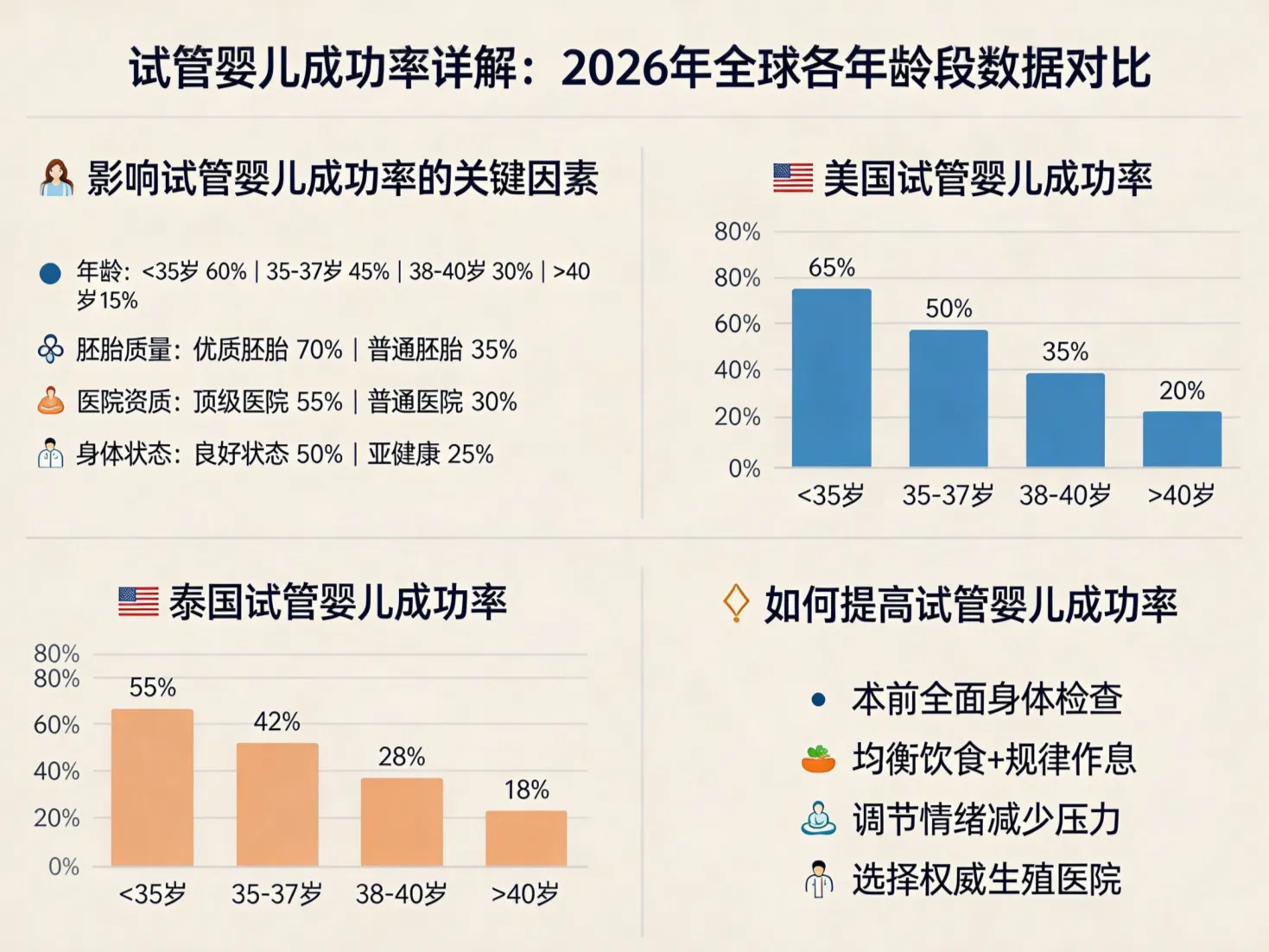
The average IVF live birth rate in 2026 is 40–50% per cycle for women under 35, falling to 20–30% at 38–40 and 5–10% over 42. Female age, ovarian reserve (AMH), embryo quality, and endometrial condition determine where you land, and every figure below comes from official sources — CDC data for the US plus reported outcomes for Thailand and Malaysia.
What Is the Average IVF Success Rate by Age?
Age is the single strongest predictor of IVF outcome: both egg quantity and egg quality decline year by year, and success rates follow. The table below pairs monthly natural conception chances with IVF live birth rates per cycle.
| Age Group | Natural Conception per Month | IVF Live Birth Rate per Cycle |
|---|---|---|
| 25–30 | 20–25% | 40–50% |
| 31–35 | 15–20% | 35–45% |
| 36–37 | 10–15% | 30–38% |
| 38–40 | 5–10% | 20–30% |
| 41–42 | 3–5% | 10–18% |
| Over 42 | under 3% | 5–10% |
“The success rates of ART procedures vary and depend on many factors, including whether the woman used her own eggs or donor eggs, the age of the woman the eggs were intended for, and whether the embryos were transferred fresh or frozen.” — U.S. Centers for Disease Control and Prevention (CDC), ART Success Rates
Three patient-level variables shape the rest of the spread:
- Ovarian reserve (AMH): above 2.0 ng/mL means good reserve and typically 10+ eggs retrieved; 1.0–2.0 ng/mL is moderate with 6–10 eggs; below 1.0 ng/mL is low reserve that may require multiple stimulation cycles.
- Embryo quality: blastocyst (day 5/6) transfers outperform cleavage-stage (day 3) embryos, and PGT-A-screened euploid embryos reach 60–70% success per transfer.
- Endometrial condition: lining health determines whether a competent embryo can actually implant.
For the full registry-level dataset behind these ranges, see our companion IVF success rate data guide.
How Successful Is IVF in the United States?
US CDC ART surveillance data reports live birth rates by transfer type, and frozen embryos now outperform fresh in every age band.
| Age Group | Fresh Embryo Transfer | Frozen Embryo Transfer | Overall |
|---|---|---|---|
| Under 35 | 42.5% | 48.2% | 45.3% |
| 35–37 | 35.8% | 41.6% | 38.7% |
| 38–40 | 26.4% | 32.1% | 29.2% |
| Over 40 | 14.2% | 21.8% | 18.0% |
Source: CDC Fertility Clinic Success Rates, collected through the CDC Assisted Reproductive Technology program.
Selected high-volume centers — HRC Fertility and Southern California Reproductive Center (SCRC) are examples — run 5–10 points above these national averages thanks to experienced teams and advanced laboratory programs. Clinic-level submissions to the national registry can be explored through the Society for Assisted Reproductive Technology, SART.
What Do Thailand and Malaysia Report?
Thai clinics combine international-standard labs with costs well below US prices, and their under-35 results are competitive:
| Age Group | Clinical Pregnancy Rate | Live Birth Rate |
|---|---|---|
| Under 35 | 50–60% | 40–48% |
| 35–37 | 40–50% | 33–42% |
| 38–40 | 30–40% | 24–33% |
| Over 40 | 15–25% | 12–20% |
Jetanin Hospital and BNH Hospital in Bangkok are among the Thai centers operating near international benchmarks; you can review accredited options on our IVF hospitals in Thailand page.
Malaysian centers report comparable numbers:
- Under 35: live birth rate approximately 38–45%
- 35–40: live birth rate approximately 25–35%
- Alpha Fertility Center (Alpha IVF) and other leading Malaysian clinics report outcomes close to Thai levels
Can You Improve Your IVF Success Rate?
Yes — the highest-leverage actions are timing, lifestyle preparation, technology matching, and psychological support, in that order.
1. Choose the Right Timing
- Success is highest when treatment starts before age 35.
- If pregnancy is not in your near-term plans, egg freezing preserves younger-egg potential.
2. Optimize Lifestyle Before Stimulation
- Keep BMI in the healthy 18.5–24.9 range.
- Stop smoking and alcohol 3–6 months before starting.
- Exercise moderately — avoid excessive intensity.
- Supplement with folic acid, CoQ10, and vitamin D.
3. Match Technology to Your Diagnosis
- PGT-A screening selects chromosomally normal embryos and lifts per-transfer success — details in our PGT-A and genetic screening guide.
- ICSI overcomes male sperm problems (see the ICSI vs IVF guide).
- Blastocyst culture gives day 5 embryos higher implantation rates.
- ERA testing pinpoints your personal transfer window.
4. Prepare Mentally
- A positive outlook and lower stress support treatment adherence.
- Support communities normalize the experience; professional counseling is appropriate when the burden grows.
What Happens After Failed Transfers?
A first failure is common and does not predict the final outcome — cumulative statistics show persistence pays:
- Success of the first transfer: approximately 35–45%
- Cumulative success after 3 transfers: approximately 65–75%
- Cumulative success after 6 transfers: approximately 80–85%
The productive response to each failure is a root-cause review with your doctor — protocol, embryo quality, endometrial factors — followed by an adjusted plan rather than a repeat of the same cycle.
FAQ
Q: Which country has the highest IVF success rate?
Technically, the United States and Spain lead globally. But individual circumstances move the number more than the flag: a 45.3% under-35 US average still hides patients whose personal odds are far higher or lower, and an experienced doctor matters more than the country’s average.
Q: Does PGT-A, or third-generation IVF, increase success rates?
Yes. A PGT-A-screened euploid embryo reaches 60–70% success per single transfer, clearly above unscreened embryos.
The benefit is largest for advanced maternal age, recurrent implantation failure, and families with known genetic conditions.
Q: Does male factor infertility affect IVF success?
Yes. Sperm motility, morphology, and DNA fragmentation directly affect fertilization and embryo quality — the 35–45% first-transfer success rate assumes sperm parameters are not a limiting factor.
In severe cases, ICSI or testicular sperm extraction resolves the fertilization barrier; see our male infertility and IVF guide.
Q: What is the IVF success rate over 40?
US CDC data puts the overall live birth rate at 18.0% per transfer for patients over 40 — 14.2% with fresh embryos and 21.8% with frozen. Thai center reporting for the same age band is 12–20% live birth, so the ranges converge across countries.
Q: How many IVF cycles does it take to succeed?
For a typical patient, cumulative live birth reaches about 65–75% after 3 transfers and 80–85% after 6. Under 35, where per-cycle rates sit at 40–50%, most successful patients need fewer cycles than patients starting in their early 40s.
Q: Does transferring a frozen embryo work better than a fresh one?
In the CDC dataset, yes, at every age: under 35 the frozen transfer live birth rate is 48.2% versus 42.5% fresh, and over 40 it is 21.8% versus 14.2%. Frozen cycles also allow PGT-A screening and a more receptive endometrium.
Is IVF Worth It in 2026?
For most patients the answer is yes — 40–50% live birth under 35 and 80–85% cumulative success after six transfers make IVF the most effective fertility treatment available, with age as the decisive variable. The practical sequence is: get evaluated early, choose technology that matches your diagnosis, and pick a clinic whose published outcomes you can verify.
To estimate your personal success rate from your age, AMH, and history, contact our medical advisors for a free assessment or compare verified clinics in our hospital directory.
This article was compiled by the ProIVF Medical Editorial Team and reviewed by the ProIVF Medical Advisory Board — about us. It is for informational purposes only and does not constitute medical advice — consult a qualified reproductive endocrinologist about your individual case. Last updated: 2026-09-20.