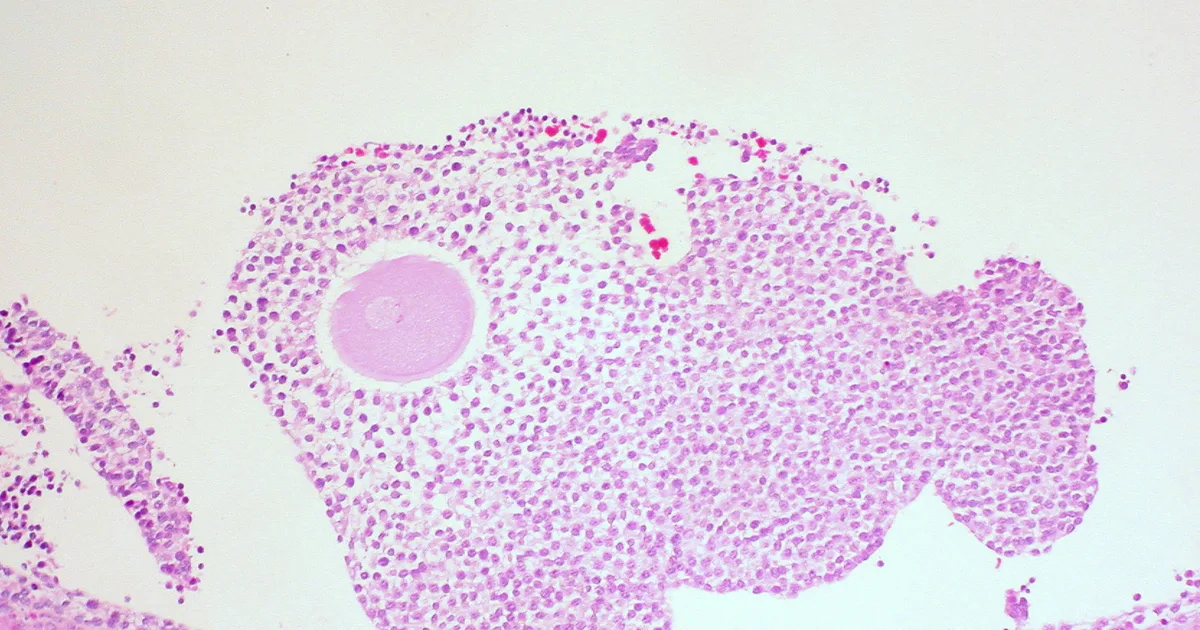
Fertilization begins in the outer third of the fallopian tube, where one sperm merges its DNA with the egg. From that first contact to the fusion of the two pronuclei, the whole sequence runs about 20 hours.
In an IVF laboratory the same events are measurable. Pronuclei appear about 6.2 hours after injection in ICSI cycles (intracytoplasmic sperm injection, one sperm into one egg), and embryologists read the result at the 16–18 hour check.
This article is compiled by the ProIVF Medical Editorial Team from peer-reviewed studies indexed in PubMed, the WHO laboratory manual for human semen analysis and patient guidance from academic medical centers. It was reviewed by the ProIVF Medical Advisory Board. It is patient education, not a substitute for your own clinic’s lab report.
Where Does Fertilization Take Place?
The ampulla — the wide, thin-walled outer third of the fallopian tube — is where fertilization normally occurs, not the uterus. Cleveland Clinic patient guidance puts it plainly: “Conception happens when sperm swims up through your vagina and fertilizes an egg in the fallopian tube.”
That location matters for treatment decisions, because it is the part of the tract a blocked or damaged tube affects first.
How do sperm get to the ampulla?
Very few of them do. The sperm-transport review (Suarez & Pacey, Human Reproduction Update 2006) states that cervical mucus “filters out sperm with poor morphology and motility and as such only a minority of ejaculated sperm actually enter the cervix.”
That same review finds only “a few thousand sperm” pass the utero-tubal junctions into the fallopian tubes. Those survivors are then held.
The review describes sperm being “stored in a reservoir, or at least maintained in a fertile state” by interacting with the oviductal epithelium. Croxatto’s physiology review (2002) calls this a reservoir that forms “at a discrete location, to hold and liberate spermatozoa in a gradual fashion.”
Capacitation and hyperactivation happen as ovulation approaches. That is what lets sperm proceed toward the ampulla and later penetrate the egg’s coverings. Guidance is partly physical and partly chemical: the review notes sperm may be steered by thermotaxis, movement along a temperature gradient, and chemotaxis, movement toward chemical signals.
| Milestone | Approximate timing | Source |
|---|---|---|
| Egg fertilizable after ovulation | 12–24 hours | Cleveland Clinic 2026 |
| Sperm survive in the female tract | up to 5 days | Cleveland Clinic 2026 |
| Sperm reaching the fallopian tubes | a few thousand per insemination | Suarez & Pacey 2006 |
| Pronuclei visible after ICSI | ~6.2 hours post-injection | Coticchio 2018 |
| Laboratory confirmation check | 16–18 hours post-insemination | standard embryology practice |
| Zygote arrives in the uterus | ~1 week after fertilization | Cleveland Clinic 2026 |
Does IVF change where fertilization happens?
Yes — IVF moves the entire event out of the tube and into a dish. The embryo goes back into the uterus on day 3 or day 5, bypassing the tube completely.
Eggs are retrieved from the follicles during egg retrieval, then inseminated or injected in the laboratory.
If the reason you cannot conceive is that sperm and egg never meet — blocked tubes, severe male factor, endometriosis — IVF replaces that missing meeting. For the day-by-day sequence after retrieval, see our fertilization and embryo timeline.
What Are the Steps of Fertilization?
Six steps, in order: capacitation, binding to the egg coat, the acrosome reaction, penetration and egg activation, pronuclear formation, and syngamy. Each is a checkpoint, and failing any one of them means no embryo.
Step 1: Capacitation — sperm must be reactivated first
Ejaculated sperm cannot fertilize an egg immediately; they need hours in the female tract to become hyperactivated. That preparation is why the fertile window spans about six days, not one day.
Capacitation strips proteins and cholesterol from the sperm membrane; hyperactivation is the forceful, whip-like beating that follows. Seminal plasma also suppresses sperm function, which is one reason laboratories wash a sample before it meets eggs in IUI or IVF cycles.
Step 2: Binding to the zona pellucida
The egg is wrapped in a glycoprotein shell called the zona pellucida. Only the few thousand sperm that reach the ampulla get this far, and binding to that shell triggers everything that follows.
This step is why sperm shape and movement are clinically relevant. Our semen analysis guide uses the WHO sixth edition reference limits: concentration 16 million/mL, total motility 42%, progressive motility 30%, normal morphology 4%. Those are the fifth-percentile values observed in men who conceived within twelve months, not diagnostic cut-offs.
Step 3: The acrosome reaction
Bound sperm release enzymes stored in the acrosome, a cap-like vesicle over the sperm head, and digest a path through the zona. Hyperactivation assists penetration of tubal mucus, the cumulus oophorus (the cells that cushion the egg) and the zona pellucida, the 2006 review notes, so the sperm can finally fuse with the oocyte membrane.
Entry depends on an enzymatic reaction, not on numbers, so a very high sperm count does not guarantee fertilization. A sample with poor acrosome function can fail even in a dish.
Step 4: Penetration, and the block to polyspermy
One sperm fuses with the egg membrane and its nucleus enters the cytoplasm. Sperm material then triggers calcium oscillations, repeated spikes of calcium inside the egg.
Those oscillations resume meiosis, expel the second polar body, and empty cortical granules, small enzyme packets sitting just under the egg membrane.
That last event is the hard stop for every other sperm:
“Following the fertilization of an egg by a single sperm, the egg coat or zona pellucida (ZP) hardens and polyspermy is irreversibly blocked.” — Nishio et al., Cell 2024
The 2024 Cell study shows that cleaving ZP2, a structural glycoprotein of the egg coat, is what makes the block permanent. It also explains why two sperm entering one egg produce a chromosomally abnormal, non-viable embryo instead of twins — see can two sperm fertilize one egg.
Step 5: Pronuclei form
The sperm nucleus decondenses and swells into the male pronucleus. The egg’s remaining chromosomes form the female pronucleus, so two separate genomes now sit inside one cell.
Time-lapse microscopy has mapped this in detail, because nothing is a complete genome until both pronuclei exist side by side. In a study of 500 injected oocytes (Coticchio et al., Human Reproduction 2018), male and female pronuclei appeared virtually simultaneously at approximately 6.2 hours post-insemination. Each appearance was preceded by a radial cytoplasmic wave that began 2–3 hours after the second polar body was expelled. A transient fertilization cone appeared in 4.3% of oocytes.
Step 6: Syngamy — the first combined genome
The two pronuclei migrate together, their membranes break down, and the parental chromosomes align on one spindle for the first division. At that moment the two sets of DNA are used together for the first time.
Coticchio’s group also found that where the male pronucleus first formed predicted what followed. It formed centrally in 53.6% of oocytes, at an intermediate depth in 31.2%, and cortically in 15.2%. Pronuclear breakdown and the first cleavage came earlier or progressively later depending on that position. Intervals between fertilization events were “strongly associated with embryo quality on Day 3,” the same group reports.
What Does ICSI Bypass, and What Does It Not Fix?
ICSI skips steps 1 to 3 entirely (capacitation, zona binding and the acrosome reaction) because the embryologist injects a single sperm directly into the cytoplasm. Everything from step 4 onward still has to happen on its own.
That distinction drives real numbers. In a SART registry analysis of 18,805 patients with unexplained infertility (F&S Reports 2024), normal two-pronuclei fertilization per oocyte retrieved was 60.9% with conventional IVF versus 59.7% with ICSI. ICSI came out slightly lower, with no gain in cumulative live birth (57.5% versus 54.4% without genetic testing).
Total fertilization failure is the reason some clinics default to ICSI: 4% of conventional IVF cycles versus 1.1% of ICSI cycles in that cohort. The authors calculated that 35 patients would need routine ICSI to prevent one cycle of total fertilization failure.
“Routine use of ICSI in unexplained infertility is not warranted due to the additional cost and lack of CLBR benefit.” — Iwamoto et al., F&S Reports 2024
ICSI adds roughly $1,500–$2,500 to a cycle in the United States. It does not repair activation failure, egg quality problems, or a sperm nucleus that cannot decondense after injection. For how method and diagnosis interact, read when IVF is used and our ICSI guide.
Can You Feel Fertilization?
No. Nothing in the 20-hour sequence from sperm contact to fused pronuclei produces a symptom a person can notice.
Cleveland Clinic answers it directly: “Can you feel conception? Not usually.” Anything felt later, such as a dull ache or light bleeding several days after conception, is attributed to implantation rather than to the sperm meeting the egg. There is no home test for fertilization itself: the earliest measurable signal is hCG, after implantation.
In an IVF cycle this gap in visibility is closed only by the laboratory. The embryologist reports the pronuclear count at the 16–18 hour check: 0PN (no pronuclei), 1PN (one, ambiguous), 2PN (normal) or 3PN (three, abnormal). Our guide to how to tell if an egg is fertilized explains each result.
What Goes Wrong Between Sperm and Egg?
Four failure points explain most cycles with no fertilization. Sperm never reach the egg, sperm cannot penetrate the zona, the egg does not activate, or pronuclei never form.
| Failure point | Typical cause | What can be done |
|---|---|---|
| Sperm never reach the egg | Blocked or removed tubes, very low total motile count, ejaculation issues | IVF bypasses the meeting entirely |
| Zona penetration fails | Progressive motility under the 30% reference limit, abnormal acrosome function, high DNA damage | ICSI; male factors contribute to about 50% of couples (20% alone, 30% alongside another cause) |
| Egg activation fails | The egg stays immature (maturation arrest) or never starts its calcium signal (oocyte activation deficiency) | assisted oocyte activation, sometimes calcium ionophore protocols |
| Pronuclei absent or abnormal | Eggs that never matured (GV/MI), two sperm entering one egg, sperm head defects | culture and trigger changes, ICSI, or a new protocol |
Sperm DNA fragmentation deserves its own line, because standard parameters can look acceptable while fertilization still underperforms. In a meta-analysis of more than 25,000 cycles (PMID 41501955), high fragmentation lowered clinical pregnancy rates, with relative ratios of 0.662 in IVF and 0.467 in IUI. ICSI was far less affected, at 0.886.
If a fertilization result disappointed you once, the question is which of the four steps broke, not whether to abandon treatment. Our male infertility and IVF guide covers the workup on that side.
Three Couples, Three Very Different Fertilization Reports
Three cycles, three very different Day 1 counts: 9 of 10 mature eggs fertilized in Boston, 2 of 7 in Bangkok, and 0 of 11 in Chicago.
Patient experiences below are anonymized composites of patterns reported by ProIVF users. Names, amounts and specific details are illustrative; your protocol, medication brand, laboratory and costs will differ — confirm everything with your clinic.
Case 1 — nine of ten mature eggs, Boston. A 34-year-old woman, first IVF cycle, twelve eggs retrieved and ten mature. The Day 1 call reported nine normally fertilized. “The nurse said nine out of ten, and I cried on the phone — I had already written off the whole cycle,” she recalled. “Then I asked her to repeat the 2PN part three times because I did not know what it meant.” Out-of-pocket cost was about $18,000. Six embryos reached blastocyst, and one transfer led to an ongoing pregnancy.
Case 2 — two of seven, then a different method. A 37-year-old woman with unexplained infertility, treated with her partner in Bangkok. In the first conventional IVF cycle, seven mature eggs produced two fertilized. “Two sounded like a verdict — we had flown from Malaysia and the cycle cost about $10,500,” she said. Progressive motility sat near the 30% reference limit, so the clinic used ICSI in cycle two: seven of nine mature eggs fertilized, and two blastocysts were frozen. The add-on cost $1,900.
Case 3 — zero, then a real diagnosis. A 32-year-old woman in Chicago had eleven mature eggs with zero fertilization in a first ICSI cycle. “I remember the embryologist going quiet. Nobody prepares you for the word zero,” she recalled. The clinic suspected oocyte activation failure. The next cycle used assisted oocyte activation and produced eight normal 2PN zygotes from ten eggs, followed by a live birth. Both cycles together cost roughly $23,000.
FAQ
Q: How long does fertilization take from start to finish?
Sperm can penetrate an egg within minutes, but combining the genetic material takes hours. Pronuclei appear about 6.2 hours after ICSI injection, and the laboratory’s confirmation window is 16–18 hours after insemination.
Q: How many sperm actually reach the egg?
A few thousand, out of tens of millions ejaculated. Cervical mucus filters out poor morphology and motility before most sperm even enter the cervix, according to the Human Reproduction Update 2006 transport review.
Q: Can fertilization happen without sexual intercourse?
Yes. In IVF, eggs are retrieved and inseminated in the lab; in ICSI a single sperm is injected into each mature egg.
Both produce the same pronuclear events the laboratory reads at the 16–18 hour check, at roughly 60% per oocyte retrieved.
Q: How soon after ovulation must fertilization occur?
The egg is fertilizable for roughly 12–24 hours after release. Sperm surviving up to 5 days in the tract is what makes the fertile window about six days long rather than a single day.
Q: What percentage of eggs fertilize normally?
Expect roughly 60% per oocyte retrieved in routine practice: the SART analysis of 18,805 patients reported 60.9% with conventional IVF and 59.7% with ICSI for unexplained infertility.
Note the denominator. It counts every egg retrieved, not only the mature ones, so immature eggs drag the percentage down even when fertilization works normally.
Q: What is total fertilization failure?
No egg fertilizes in a cycle. It occurred in 4% of conventional IVF cycles and 1.1% of ICSI cycles in that cohort; the usual next step is diagnostic workup plus a change of insemination method or assisted oocyte activation.
Q: Does ICSI raise the chance of fertilization for everyone?
No. Routine ICSI in unexplained infertility produced slightly lower fertilization per oocyte (59.7% versus 60.9%).
It brought no cumulative live-birth gain (54.4% versus 57.5%) while adding $1,500–$2,500 in cost. The authors’ own trade-off figure: 35 patients would need routine ICSI to prevent a single cycle of total fertilization failure.
Q: Can you choose the sex of the baby at fertilization?
Not at fertilization. Sex is decided by one of two chromosomes, X or Y, carried by whichever sperm fuses at the moment of conception.
Only PGT genetic screening of created embryos can reveal it, and non-medical sex selection is restricted in most destinations.
Your Next Step
Fertilization is the least visible and most decisive of the six steps in reproduction — invisible inside the body, measurable inside the lab. If you are trying naturally, the practical variables are timing relative to ovulation and how long you have been trying.
If you are in treatment, the practical variable is which of the six steps broke in your cycle.
Ask your clinic for the Day 1 numbers in writing: mature eggs, 2PN count, Day 3 cleavage, Day 5 blastocysts. That trail, not a single phone call, is what shapes the next protocol. Compare clinics by how their laboratories report results in our hospital directory, or contact us about a second opinion after a failed fertilization cycle.
This article was written by the ProIVF Medical Editorial Team and reviewed by the ProIVF Medical Advisory Board, based on peer-reviewed studies indexed in PubMed, the WHO laboratory manual for human semen analysis, and patient guidance from Cleveland Clinic, to provide objective, accurate information for patients.
Medical disclaimer: This content is for informational purposes only and does not constitute medical advice. Fertility outcomes vary by individual diagnosis, age and clinic. Always consult a licensed reproductive specialist about your specific situation. Questions? Contact us.
Last updated: October 5, 2026